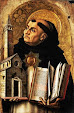
St. Barnabas, Apostle
The Church, founded by Jesus and filled with the Holy Ghost at Pentecost, was to spread throughout the world. When St. Paul, after his long retreat in Arabia, came to Jerusalem for the first time after his conversion, and wished to submit to the approval of Peter the mission to the Gentiles committed to him by the Master Himself, it was St. Barnabas who presented him to the apostles.
"A good man and full of the Holy Ghost" (Epistle), St. Barnabas evangelized, during twelve years, with St. Paul, the pagans in the island of Cyprus and in a great number of towns and countries (Gradual). Wherefore the Church honours him as an apostle and the liturgy applies to him the words of Jesus announcing to the twelve that having been established as princes over the whole earth (Offertory), they would be seated on thrones to judge the twelve tribes of Israel (Communion). Having separated from St. Paul, he returned to Cyprus where the Jews of Salamis plotted against him. Remembering then the words of the Master who sent His apostles like sheep in the midst of wolves (Gospel), he said to the faithful: "The wolf only attacks the shepherd first to throw himself next upon the flock. Be firm in the faith." The Holy Ghost dictated to him the words he had to say to the Jews (Gospel): but they stoned him as a blasphemer. He was buried with the Gospel of St. Matthew which he had copied with his own hand. His name is mentioned in the Canon of the Mass immediately after that of St. Matthias (second list).
Let us imitate the apostolic spirit of St. Barnabas whose soul was all inflamed with the Holy Ghost.
Mihi autem nimis honorati sunt amici tui, Deus: nimis confortatus est principatus eorum. * Domine, probasti me, et cognovisti me: tu cognovisti sessionem meam, et resurrectionem meam.
To me Thy friends, O God, are made exceedingly honourable: their principality is exceedingly strengthened. * Lord, Thou hast proved me, and known me; Thou hast known my sitting down and my rising up.
(Psalm 138:17,1-2 from the Introit of Mass).
Deus, qui nos beati Barnabae Apostoli tui meritis et intercessione laetificas: concede propitius; ut, qui tua per eum beneficia poscimus, dono tuae gratiae consequamur.
O God, who givest us joy by the merits and intercession of blessed Barnabas, Thy apostle, mercifully grant that we, who beg blessings of Thee through him, may obtain them by the gift of Thy grace.
(Collect)
From the Catholic Encyclopaedia: http://www.newadvent.org/cathen/02300a.htm
Saturday, 11 June 2016
Friday, 10 June 2016
10th June, St Margaret of Scotland
St Margaret, Queen of Scots

Margaret, queen of Scotland, was descended from the English kings by her father and from the Caesars by her mother. Like the prudent woman, mentioned in the Epistle, she was made still more illustrious by the practice of Christian virtues.
Filled with the fear of God (Introit), she subjected herself to fearful mortifications and by her example she brought the King, her husband, to a better life and her subjects to more Christian morals. She brought up her eight children with such piety that several of them led a life of high perfection. Nothing, however, was more admirable in her than her ardent charity towards her neighbour (Collect). She was called the mother of orphans and the treasurer of the poor of Jesus Christ. Such was the price at which she bought the precious pearl of the Kingdom of Heaven (Gospel).
Purified by six months of bodily suffering, she gave up her soul to God in 1093 at Edinburgh. The holiness of her life and numerous miracles wrought after her death have made her worship celebrated in the whole world. She was chosen by Clement X as patron of the Scottish nation over which she had reigned for thirty years.
Let us admire the work of the Holy Ghost in the soul of the holy queen whom He chose for the furtherance of Christ's Kingdom in Scotland and let us invoke her for the return of Scotland to Roman unity.
Deus, qui beatam Margaritam reginam eximia in pauperes caritate mirabilem effecisti: da; ut ejus intercessione et exemplo, tua in cordibus nostris caritas jugiter augeatur.
O God, who didst imbue the blessed queen Margaret with a spirit of singular charity towards the poor: grant that, through her prayers and example, Thy love may ever grow in our hearts.
(Collect)
From the Catholic Encyclopaedia: http://www.newadvent.org/cathen/09655c.htm

Margaret, queen of Scotland, was descended from the English kings by her father and from the Caesars by her mother. Like the prudent woman, mentioned in the Epistle, she was made still more illustrious by the practice of Christian virtues.
Filled with the fear of God (Introit), she subjected herself to fearful mortifications and by her example she brought the King, her husband, to a better life and her subjects to more Christian morals. She brought up her eight children with such piety that several of them led a life of high perfection. Nothing, however, was more admirable in her than her ardent charity towards her neighbour (Collect). She was called the mother of orphans and the treasurer of the poor of Jesus Christ. Such was the price at which she bought the precious pearl of the Kingdom of Heaven (Gospel).
Purified by six months of bodily suffering, she gave up her soul to God in 1093 at Edinburgh. The holiness of her life and numerous miracles wrought after her death have made her worship celebrated in the whole world. She was chosen by Clement X as patron of the Scottish nation over which she had reigned for thirty years.
Let us admire the work of the Holy Ghost in the soul of the holy queen whom He chose for the furtherance of Christ's Kingdom in Scotland and let us invoke her for the return of Scotland to Roman unity.
Cognovi, Domine, quia aequitas judicia tua, et in veritate tua humiliasti me: confige timore tuo carnes meas, a mandatis tuis timui. * Beati immaculati in via, qui ambulant in lege Domini.
I know, O Lord, that Thy judgements are equity, and in Thy truth Thou hast humbled me: pierce Thou my flesh with Thy fear, I am afraid of Thy judgements. * Blessed are the undefiled in the way, who walk in the law of the Lord.
(Psalm 118:75 and 120:1 from the Introit of Mass).
Deus, qui beatam Margaritam reginam eximia in pauperes caritate mirabilem effecisti: da; ut ejus intercessione et exemplo, tua in cordibus nostris caritas jugiter augeatur.
O God, who didst imbue the blessed queen Margaret with a spirit of singular charity towards the poor: grant that, through her prayers and example, Thy love may ever grow in our hearts.
(Collect)
From the Catholic Encyclopaedia: http://www.newadvent.org/cathen/09655c.htm
Thursday, 9 June 2016
Corpus Christi
Feast of Corpus Christi
After the dogma of the Holy Trinity, the Holy Spirit reminds us of the dogma of the Incarnation of our Lord, in celebrating with the Church the greatest of all sacraments, summing up the whole life of the Redeemer, giving infinite glory to God and applying the fruits of the Redemption at all times to ourselves (Collect).
It was on the cross that our Lord redeemed us and the Holy Eucharist, instituted on the night before our Lord's Passion, remains its memorial (Collect). The altar is the extension of Calvary; the Mass "shows the death of the Lord " (Epistle). (The celebration of the Mass has the same value as the death of Jesus Christ on the cross," St. John Chrysostom.)
Jesus is there in the state of a victim, for the words of the double consecration mean only that the bread is changed into the Body of Christ and the wine into His Blood. On account of this double action with different effects, which constitutes the sacrifice of the Mass, we are entitled to speak of our Lord's Presence under the appearance of bread as that of the Body of Christ, although, since He can die no more, the whole Christ is there contained; similarly we may speak of the Presence under the appearance of wine as that of His Blood, although He is contained there whole and entire.
Through His priests, our Lord Himself, the principal Priest of the Mass, offers in an unbloody manner His Body and Blood which were really separated on the Cross, but on the altar only in a representative or sacramental sense, the matter and words used and the effect produced being different in the two consecrations. Besides, the Eucharist was instituted under the form of food (Alleluia), that we may be united with the Victim of Calvary, so that the Sacred Host becomes the "wheat " which feeds our souls (Introit).
Moreover, Christ, as the Son of God, receives the eternal life of the Father; in the same way Christians share in that eternal life by uniting themselves to Christ through the Sacrament which is the symbol of unity (Secret), and this possession of the divine life, already realized on earth through the Eucharist, is the pledge and the beginning of that in which we shall fully rejoice in heaven (Postcommunion). As the Council of Trent puts it: "That same Heavenly Bread that we eat now under the sacred veils, we shall feed upon in heaven without veil."
We should regard the Mass as the centre of all Eucharistic worship, seeing in Holy Communion the means instituted by our Lord to enable us to share more fully in this divine Sacrifice. In this way our devotion to our Lord's Body and Blood will effectively obtain for us the fruits of His Redemption (Collect).
Concerning the procession which regularly should follow the Mass, we remember how the Israelites revered the Ark of the Covenant which was the Presence of God among them. When they carried on their victorious marches, the Ark went before, born by the Levites in the midst of a cloud of incense, accompanied by the sound of musical instruments and of the songs and shouts of the multitude
We Christians have a treasure far more precious, for in the Eucharist we possess God Himself. Let us feel a holy pride in forming His escort and extolling His triumphs, while He is in our midst.
Cibavit eos ex adipe frumenti, alleluia: et de petra, melle saturavit eos, alleluia, alleluia, alleluia. * Exsultate Deo adjutorio nostro; jubilate Deo Jacob.
He fed them with the fat of wheat, alleluia; and filled them with honey out of the rock, alleluia, alleluia, alleluia. * Rejoice unto God our helper; sing aloud to the God of Jacob.
(Psalm 80:17,2 from the Introit of Mass)
Deus, qui nobis sub Sacramento mirabili passionis tuae memoriam reliquisti: tribue, quaesumus, ita nos Corporis et Sanguinis tui sacra mysteria venerari; ut redemptionis tuae fructum in nobis jugiter sentiamus.
O God, who in this wonderful sacrament has left us a memorial of Thy passion, grant us, we beseech Thee, so to venerate the sacred mysteries of Thy Body and Blood, that we may ever perceive within us the fruit of Thy redemption.
(Collect)
Continuation of the holy Gospel according to St. John.
At that time Jesus said to the multitudes of the Jews: My Flesh is meat indeed, and My Blood is drink indeed. He that eateth My Flesh, and drinketh My Blood, abideth in Me, and I in him. As the living Father hath sent Me, and I live by the Father, so he that eateth Me, the same also shall live by Me. This is the bread that came down from Heaven. Not as your fathers did eat manna and are dead. He that eateth this Bread shall live for ever.
(St. John 6:56-59)
From the Catholic Encyclopaedia: http://www.newadvent.org/cathen/04390b.htm
9th June, SS. Primus and Felician, Martyrs
SS. Primus and Felician, Martyrs
Primus and Felician were Romans. Brothers by blood, they became brothers still more when, having been called to bear much fruit (Offert ofory), they confessed their faith in Jesus Christ. Accused and arrested under Diocletian and Maximian, they were, in spite of their great age, cast into prison.
The Holy Ghost filled them "with His virtue and His strength " (Offertory). Giving them the breast-plate of justice and the impenetrable shield of equity (Epistle), He made them experience how sweet is the yoke of the Lord, which they had taken upon themselves, and how light is His burden (Gospel).
The constancy of Felician was first put to the test. Nailed by his hands and feet to the trunk of a tree, he remained hanging there for three days, without eating or drinking. They then tried to make his brother believe that he had sacrificed to the idols, but Primus declared that he knew Felician was happy in the midst of his sufferings and that he would remain united to him in martyrdom. "This is," as the Alleluia sings, "the true brotherhood which has triumphed over the criminal world." The praetor then ordered that molten lead should be poured into his mouth, in the presence of his brother.
They were led to the amphitheatre, but the lions who were to devour them crouched at their feet. Finally they were beheaded (286).
Their names live as centuries roll on (Introit), for they have received in heaven, from the hand of the Lord, a kingdom of glory and a crown of sparkling beauty (Epistle).
Let us join in heart, the faithful of Rome who, on this day, honour the precious remains of these two martyrs at the Church of St. Stephen on Mount Coelius.
In Paschal Time:
Fac nos, quaesumus, Domine, sanctorum Martyrum tuorum Primi et Feliciani semper festa sectari: quorum suffragiis protectionis tuae dona sentiamus.
Make us, we beseech Thee, O Lord, ever to celebrate worthily the feast of Thy holy martyrs Primus and Felician: and by their loving intercession ever to feel Thy protection.
(Collect)
From the Catholic Encyclopaedia: http://www.newadvent.org/cathen/12427a.htm
Primus and Felician were Romans. Brothers by blood, they became brothers still more when, having been called to bear much fruit (Offert ofory), they confessed their faith in Jesus Christ. Accused and arrested under Diocletian and Maximian, they were, in spite of their great age, cast into prison.
The Holy Ghost filled them "with His virtue and His strength " (Offertory). Giving them the breast-plate of justice and the impenetrable shield of equity (Epistle), He made them experience how sweet is the yoke of the Lord, which they had taken upon themselves, and how light is His burden (Gospel).
The constancy of Felician was first put to the test. Nailed by his hands and feet to the trunk of a tree, he remained hanging there for three days, without eating or drinking. They then tried to make his brother believe that he had sacrificed to the idols, but Primus declared that he knew Felician was happy in the midst of his sufferings and that he would remain united to him in martyrdom. "This is," as the Alleluia sings, "the true brotherhood which has triumphed over the criminal world." The praetor then ordered that molten lead should be poured into his mouth, in the presence of his brother.
They were led to the amphitheatre, but the lions who were to devour them crouched at their feet. Finally they were beheaded (286).
Their names live as centuries roll on (Introit), for they have received in heaven, from the hand of the Lord, a kingdom of glory and a crown of sparkling beauty (Epistle).
Let us join in heart, the faithful of Rome who, on this day, honour the precious remains of these two martyrs at the Church of St. Stephen on Mount Coelius.
In Paschal Time:
Sancti tui, Domine, benedicent te: gloriam regni tui dicent, alleluia, alleluia. * Exaltabo te, Deus meus Rex: et benedicam nomini tuo in saeculum, et in saeculum saeculi.
Let the saints bless Thee, O Lord; they shall speak of the glory of Thy kingdom, alleluia, alleluia. * I will extol Thee, O God my King: and I will bless Thy name for ever; yea, for ever and ever.
(Psalm 144:10-11,1 from the Introit of Mass)
Fac nos, quaesumus, Domine, sanctorum Martyrum tuorum Primi et Feliciani semper festa sectari: quorum suffragiis protectionis tuae dona sentiamus.
Make us, we beseech Thee, O Lord, ever to celebrate worthily the feast of Thy holy martyrs Primus and Felician: and by their loving intercession ever to feel Thy protection.
(Collect)
From the Catholic Encyclopaedia: http://www.newadvent.org/cathen/12427a.htm
9th June, Translation of St Edmund, Bishop and Confessor
Translation of St Edmund, Bishop and Confessor
(Portsmouth and Brentwood)
The body of St Edmund, Archbishop of Canterbury - also known as St Edmund Rich or St Edmund of Abingdon - was buried at Pontigny in France, 1240. It was taken up on 9th June 1247, seven years after his death, found entire and incorrupt, and solemnly translated to a more honourable sepulchre, in the presence of St Louis, King of France, and a great number of prelates and noblemen.
Gaudeamus omnes in Domine Diem festum celebrantes sub honore beati Edmundi: de cujus solemnitate gaudent Angeli, et collaudant Filium Dei. * Exsultate justi in Domino: rectos decet collaudatio.
Let us all rejoice in the Lord, whilst celebrating this festival in honour of blessed Edmund, on whose solemnity the angels rejoice, and praise the Son of God. * Rejoice in the Lord, O ye just: praise becometh the upright.
(Introit of Mass, Psalm 32)
Deus, qui nos concedis beati Edmundi, Confessoris tui atque Pontificis translationem colere: da nobis ejus meritis et precibus; ut a peccati servitute soluti, ad regni coelestis gaudia transire valeamus.
O God, by whose grace we celebrate the translation of blessed Edmund, they confessor and bishop, grant us by his merits and prayers that we may be freed from the slavery of sin, and be able to pass to thejoys of the heavenly kingdom.
(Collect)
Catholic Encyclopaedia on St Edmund: http://www.newadvent.org/cathen/05294a.htm
Wikipedia on St Edmund of Canterbury: http://en.wikipedia.org/wiki/Edmund_Rich
Wednesday, 8 June 2016
8th June, St William of York, Bishop and Confessor
St William of York, Bishop and Confessor
Sacerdotes tui, Domine, induant justitiam, et sancti tui exsultent: propter David servum tuum, non avertas faciem Christi tui. * Memento, Domine, David et omnis mansuetudinis ejus.
Let Thy priests, O Lord, be clothed with justice, and let Thy saints rejoice: for thy servant David's sake, turn not away the face of Thy anointed. * O Lord, remember David and all his meekness.
(Psalm 131:9-10,1 from the Introit of Mass)
O God, who dost gladden us by the merits and intercession of blessed William, Thy confessor and bishop; mercifully grant that we who ask his favours may gain them by the gift of thy grace.
(Collect)
From the Catholic Encyclopaedia: http://www.newadvent.org/cathen/15628c.htm
Monday, 6 June 2016
6th June, St. Norbert, Bishop and Confessor
St. Norbert, Bishop and Confessor
Norbert, born in 1080 at Xanten near Cologne, was educated at the Emperor's Court. One day when he was riding accompanied by a servant he was surprised by a hurricane. Like St. Paul, on the way to Damascus, he heard a voice calling him to the service of the Church. At this moment a crash of thunder threw him to the ground. He got up again, determined to consecrate himself to God. Having been admitted to holy orders, he devoted himself entirely to preaching the word of God (Collect).
Later on, guided by the Holy Ghost, who continually sanctifies the Church through the centuries, he chose a retreat in a deserted spot, called Premontre, not far from Soissons, and founded there the Order of Premonstratensians (Collect). At the death of this holy Founder, this new family numbered at this place alone over one thousand Canons Regular. St. Norbert shared the full priesthood of Christ, being anointed archbishop of Magdeburg (Introit, Epistle, Gradual, Offertory). He helped Pope Innocent II to triumph over the anti-pope Anacletus and was the friend of St. Bernard. In the Netherlands, he defended Eucharistic worship against the heresy of Tanchelmus (see engraving).
After having put to full profit the talents with which God had entrusted him for the government of his religious family and diocese (Gospel, Communion), "This man of God," says the breviary, "full of the Holy Ghost and laden with merits, fell asleep in the Lord, A.D. 1134."
Let us ask of God "to practise what St. Norbert taught by word and by example" (Collect).
Deus, qui beatum Norbertum, Confessorem tuum atque Pontificem, verbi tui praeconem eximium effecisti, et per eum Ecclesiam tuam nova prole fecundasti: praesta, quaesumus; ut, ejusdem suffragantibus meritis, quod ore simul et opere docuit, te adjuvante, exercere valeamus.
O God, who didst raise up blessed Norbert, Thy confessor and bishop, to be an illustrious preacher of Thy word, and through him didst beget another Order in Thy church; grant, we beseech Thee, that through the pleading of his merits, we may practise by Thy grace that which he taught both by word and deed.
Norbert, born in 1080 at Xanten near Cologne, was educated at the Emperor's Court. One day when he was riding accompanied by a servant he was surprised by a hurricane. Like St. Paul, on the way to Damascus, he heard a voice calling him to the service of the Church. At this moment a crash of thunder threw him to the ground. He got up again, determined to consecrate himself to God. Having been admitted to holy orders, he devoted himself entirely to preaching the word of God (Collect).
Later on, guided by the Holy Ghost, who continually sanctifies the Church through the centuries, he chose a retreat in a deserted spot, called Premontre, not far from Soissons, and founded there the Order of Premonstratensians (Collect). At the death of this holy Founder, this new family numbered at this place alone over one thousand Canons Regular. St. Norbert shared the full priesthood of Christ, being anointed archbishop of Magdeburg (Introit, Epistle, Gradual, Offertory). He helped Pope Innocent II to triumph over the anti-pope Anacletus and was the friend of St. Bernard. In the Netherlands, he defended Eucharistic worship against the heresy of Tanchelmus (see engraving).
After having put to full profit the talents with which God had entrusted him for the government of his religious family and diocese (Gospel, Communion), "This man of God," says the breviary, "full of the Holy Ghost and laden with merits, fell asleep in the Lord, A.D. 1134."
Let us ask of God "to practise what St. Norbert taught by word and by example" (Collect).
Statuit ei Dominus testamentum pacis, et principem fecit eum: ut sit illi sacerdotii dignitas in aeternum. * Memento Domine David et omnis mansuetudinis ejus.
The Lord made to him a covenant of peace, and made him a prince; that the dignity of the priesthood should be to him for ever. * O Lord, remember David: and all his meekness.
(Ecclus. 45:30 and Psalm 131:1. From the Introit at Mass).
Deus, qui beatum Norbertum, Confessorem tuum atque Pontificem, verbi tui praeconem eximium effecisti, et per eum Ecclesiam tuam nova prole fecundasti: praesta, quaesumus; ut, ejusdem suffragantibus meritis, quod ore simul et opere docuit, te adjuvante, exercere valeamus.
O God, who didst raise up blessed Norbert, Thy confessor and bishop, to be an illustrious preacher of Thy word, and through him didst beget another Order in Thy church; grant, we beseech Thee, that through the pleading of his merits, we may practise by Thy grace that which he taught both by word and deed.
Subscribe to:
Posts (Atom)