Fourteenth Sunday after Pentecost
The lessons of this Sunday's office are often taken from Ecclesiasticus or Job, according as the Sunday falls in August (4th or 5th Sunday) or September (1st or 2nd Sunday).
Commenting on the former, St. Gregory says: "There are men all athirst for passing joys who are ignorant or indifferent where eternal blessings are concerned. Poor wretches! They congratulate themselves on possessing the good things of this life without regretting those of the world above, which they have lost. Fashioned for light and truth, they never lift up the eyes of the soul; never betray the smallest desire or longing for the contemplation of their eternal home. Giving themselves over to the pleasures among which they are thrown, they bestow their affection upon a dreary place of exile as if it were their fatherland; and surrounded by darkness, they are full of rejoicing as if they were illumined by a brilliant light. On the other hand the elect, in whose eyes fleeting goods are of no value, seek after those for which their souls were made. Kept in this world by the bonds of the flesh, each, none the less, is carried in spirit beyond it while making the wholesome resolve to despise the passing things of time and to desire the things which endure for eternity."
As for Job, he is set before us in Holy Scripture as the very type of a man detached from the goods of this world. " If," said he, "we have received good things at the hands of God, why should we not receive evil?... The Lord gave, and the Lord hath taken away ... Blessed be the name of the Lord."
The proper of to-day's Mass is inspired by the same thoughts The Holy Ghost, whom the Church received at Pentecost, has formed a new man in us who resists the outward manifestations of the old man, namely covetousness and the search for riches, in order to satisfy it. The Spirit of God is a spirit of liberty, who by making us children of God, our Father, and brethren of Jesus our Lord, frees us from the slavery of sin and the tyranny of concupiscence. " They that are Christ's, " says St. Paul, " have crucified their flesh with the vices and concupiscences." " Walk in the spirit, and you shall not fulfil the lusts of the flesh : for the flesh lusteth against the spirit and the spirit against the flesh; for these are contrary one to another" (Epistle). And our Lord says: "No man can serve two masters; for either he will hate the one and love the other, or he will sustain the one and despise the other. You cannot serve God and Mammon."
St. Augustine, in expounding this passage, says: "Whoever is the slave of riches (and we know that only too often they are the source of pride, avarice, injustice and lust)1 is subject to a hard and wicked master. Entirely at the mercy of his passions, he is under the tyranny of the devil. Certainly he does not love him, for who can love the devil? But all the same he endures him. On the other hand he does not hate God, for this, no man's conscience will let him do, but he despises Him, that is, he does not fear Him, as if he were sure of His goodness.
"The Holy Ghost puts us on our guard against this negligence and pernicious sense of security, when He says by the Prophet: 'Say not: The mercy of the Lord is great.' (Ecclesiasticus, 5:6), but know that 'the benignity of God leadeth thee to penance' (Romans 2:4). For who is more merciful than He who pardons the sins of all who turn to Him, and who gives the fertility of the olive to the wild branch? And who is more severe than He who has not spared the natural branches but because of their infidelity has cut them off? If anyone wishes to love God and to contrive never to offend Him, let him not think that he can serve two masters; let him have a single intention free from duplicity. Thus must you think about the Lord's goodness, and seek Him in simplicity of heart. Therefore," he goes on, "I tell you not to have any superfluous anxiety as to what you will eat and what you will put on, lest perhaps, without seeking superfluities, the heart may become double, and in pursuing what is necessary, your intention may be turned aside to seek your own interests rather than the advantage of your neighbour." (3rd Nocturn).
Before all, then, let us seek the kingdom of God, and His justice and glory (Gospel, Communion); let us put all our hope in the Lord for He is our protector (Introit); it is He who sends His angels to deliver those who serve Him (Offertory), and who upholds our weak human nature, for without this divine assistance it would surely fail (Gospel). It is the Eucharist which wins for us the favour of Almighty God (Secret) which by strengthening us makes our salvation sure (Postcommunion).
Let us love, above all things, to pray in the courts of the Lord (verse of the Introit), and to go there to sing the praises of God our Saviour (Alleluia). Then let us look after our temporal affairs but without being unduly anxious about them. Such solicitude would be an outrage to our heavenly Father who loves His children, and who lets them want for nothing provided they seek His glory before all else.
1. "Do not," asks St. John Chrysostom, "these daily feasts, these orgies, these theatres, these riches, bear witness to the insatiable greed of your evil passions?" (2nd Nocturn of the fifth Sunday of August, which sometimes coincides with this Sunday).
2. These words are taken from the 1st Nocturn of the fifth Sunday of August: "Say not: The mercy of the Lord is great; He will have mercy on the multitude of my sins, for mercy and wrath quickly come from Him: and His wrath looketh upon sinners. Delay not to be converted to the Lord: and defer it not from day to day. For His wrath shall come on a sudden: and in the time of vengeance He will destroy thee. Be not anxious for goods unjustly gotten: for they shall not profit thee in the day of calamity and revenge." (See 2nd Nocturn.)
Protector noster, aspice, Deus, et respice in faciem Christi tui: quia melior est dies una in atriis tuis super millia. * Quam dilecta tabernacula tua, Domine virtutum! concupiscit et deficit anima mea in atria Domini.
Behold, O God, our protector, and look on the face of Thy Christ: for better is one day in Thy courts above thousands. * How lovely are Thy tabernacles, O Lord of hosts! my soul longeth and fainteth for the courts of the Lord.
(Psalm 83:1-3, from the Introit of Mass)
Custodi, Domine, quaesumus, Ecclesiam tuam propitiatione perpetua: et quia sine te labitur humana mortalitas; tuis semper auxlliis et abstrahatur a noxiis, et ad salutaria dirigatur.
Keep, we beseech Thee, O Lord, Thy Church with perpetual peace; and because the frailty of man without Thee cannot but fall, keep us ever by Thy help from all things hurtful, and lead us to all things profitable to our salvation.
(Collect)
Sequentia sancti Evangelii secundum Matthaeum.
In illo tempore: Dixit Jesus discipulis suis: Nemo potest duobus dominis servire: aut enim unum odio habebit, et alterum diliget: aut unum sustinebit, et alterum contemnet. Non potestis Deo servire, et mammonae. Ideo dico vobis, ne solliciti sitis animae vestrae quid manducetis, neque corpori vestro quid induamini. Nonne anima plus est quam esca: et corpus plus quam vestimentum? Respicite volatilia caeli, quoniam non serunt, neque metunt, neque congregant in horrea: et Pater vester caelestis pascit illa. Nonne vos magis pluris estis illis? Quis autem vestrum cogitans potest adjicere ad staturam suam cubitum unum? Et de vestimento quid solliciti estis? Considerate lilia agri quomodo crescunt: non laborant, neque nent. Dico autem vobis, quoniam nec Salomon in omni gloria sua coopertus est sicut unum ex istis. Si autem foenum agri, quod hodie est, et eras in clibanum mittitur, Deus sic vestit: quanto magis vos modicae fidei? Nolite ergo solliciti esse, dicentes: Quid manducabimus aut quid bibemus, aut quo operiemur? Haec enim omnia gentes inquirunt. Scit enim Pater vester, quia his omnibus indigetis. Quaerite ergo primum regnum Dei, et justitiam ejus: et haec omnia adjicientur vobis.
Continuation of the holy Gospel according to St. Matthew.
At that time Jesus said to His disciples: No man can serve two masters; for either he will hate the one and love the other, or he will sustain the one and despise the other. You cannot serve God and mammon. Therefore I say to you, be not solicitous for your life, what you shall eat, nor for your body, what you shall put on. Is not the life more than the meat, and the body more than the raiment? Behold the birds of the air; for they neither sow nor do they reap, nor gather into barns, and your heavenly Father feedeth them. Are you not of much more value than they? And which of you, by taking thought, can add to his stature one cubit? And for raiment why are you solicitous? Consider the lilies of the field, how they grow; they labour not, neither do they spin; but I say to you, that not even Solomon in all his glory was arrayed as one of these. Now if God so clothe the grass of the field, which is to-day, and tomorrow is cast into the oven, how much more you, O ye of little faith! Be not solicitous therefore saying, what shall we eat, or what shall we drink, or wherewith shall we be clothed, for after all these things do the heathens seek, For your Father knoweth that you have need of all these things. Seek ye therefore first the Kingdom of God, and His justice; and all these things shall be added unto you.
(St Matthew 6:24-33)
Quaerite primum regnum Dei, et justitiam ejus, et haec omnia adjicientur vobis, alleluia.
Seek ye first the Kingdom of God and His justice, and all these things shall be added unto you, alleluia.
(Antiphon at the Magnificat: Matt. 6)
Sunday, 26 August 2018

Sunday, 19 August 2018
13th Sunday after Pentecost
Thirteenth Sunday after Pentecost
 Continuing with the reading of the sapiential books which began last Sunday (first Sunday of August) the Church orders the Book of Ecclesiastes to be commenced in the breviary lessons on the second Sunday of August.
"Vanity of vanities," says the sacred author, "and all is vanity. There is no remembrance of former things : nor indeed of those things which hereafter are to come, shall there be any remembrance within them that be in the latter end. I have seen all things that are done under the sun: and behold all is vanity and vexation of spirit. The perverse are hard to be corrected, and the number of fools is infinite " (1st Nocturn)
"As soon," says St. John Chrysostom, "as Solomon was enabled to perceive the divine Wisdom, he uttered this sublime exclamation, worthy of heaven itself: 'Vanity of vanities, and all is vanity.' You, in your turn can bear a like witness, if you will. It is true that Solomon in past ages was not bound, to seek wisdom so diligently as we, since the Old Law did not regard the enjoyment of superfluities as vanity, though none the less, men could see that they were worthless and deserving of contempt. But we are called to more perfect virtues, scale loftier heights, and give ourselves to nobler practices. In a word, what can we say, but that we are commanded to regulate our conduct after the pattern of heavenly virtues which have nothing fleshly about them and are entirely spiritual" (2nd Nocturn).
These heavenly virtues are principally the theological ones, " faith, hope and charity", for which we ask God in the Collect, so that we may love what He commands (Collect). Moreover, for this reason, the Church takes for to-day's Epistle a passage from St. Paul's Epistle to the Corinthians, the subject of which is faith in Jesus Christ, a faith which works by charity and which makes us, like Abraham of old, put our hope in this divine Redeemer. For it is by this faith, manifested in good works and trust in God, that souls, covered with the leprosy of sin, are cured, as we are reminded in to-day's Gospel. The ten lepers, who in some sense stand for the transgressions of men against the ten commandments, see from afar their divine Healer, and put their trust in Him. " Master, have mercy on us." Their faith issues in works, for when our Lord puts them to the test, telling them : "Go show yourselves to the priest," they obey without hesitation and are cured on the way. But the cure is only confirmed in the case of one of them who returns to Jesus to express his thanks. " And one of them, when he saw that he was made clean, went back, with a loud voice glorifying God ; and he fell on his face before His feet, giving thanks." And Jesus said to him: "Arise, go thy way, for thy faith hath made thee whole."
Hence we learn that it is faith in Christ that saves souls. For here is St Augustine's interpretation of this gospel in the homily for to-day : " Our Lord does not say of those men who were freed from leprosy that they were cured, but purified ; for leprosy alters the colour of the skin without, generally, taking away the integrity of the senses and members of the body.
It is not, therefore, absurd to see in the lepers, a type of those who, being without the science of the true faith, profess the changing doctrines of error. For they do not conceal their ignorance, but bring it out into the light, making it pass for superior knowledge and showing it off in boastful talk. Now there is no false doctrine which does not contain a mixture of truth. These truths and errors, mingled haphazard, in a single discussion or narrative, are like differences of colour appearing in the same body, and represent leprosy which covers human bodies with spots, forming with the sound parts, diversity of colour.
This sort of leper the Church is bound to exclude, so that, if possible, seeing themselves thrust far from her, they may set themselves to call, with loud cries upon Christ, like the ten men that were lepers, who stood afar off, and lifted up their voices saying: c Jesus, Master, have mercy on us.'
Now if our Lord worked cures in person He leaves to the Church the task of spreading His doctrine and instructing, both by word and pen. Thus St. Paul was sent to Ananias to receive, from the duly constituted priesthood of the Church, the sacrament of faith. And later, the Apostle will go uj) to Jerusalem with Barnabas and Titus so that by jointly professing the doctrine of the faith before the congregation by this very reunion they might show that they had one single doctrine, excluding every kind of variation. It is about this that St Paul wisely warns the Corinthians : " I beseech you brethren, that you all speak the same thing " (Matins).
The Gospel narrative also foretells the rejection of the Jews who were ungrateful toward Him who came to cure them, while the Gentiles have been faithful. For among the ten lepers, nine were Jews and only one was not, and it was to this single Samaritan who came to thank our Lord that He said: "Thy faith hath made thee whole," showing that it is not only to the children of Abraham by blood that this promise has been made, but also to those who are his children because they share his faith in Jesus Christ, for it is by this faith that the promise of eternal life which was made to Abraham is extended to all nations. So the prayer after the third prophecy on Holy Saturday reminds us that God "by the paschal sacrament (Baptism)" made His servant Abraham, according to His oath, " the father of all nations", while the fourth prayer adds : " Grant that all the nations of the world may become the children of Abraham, and partake of the (lost) dignity of the people of Israel."
The Gentiles occupy the place of the Jews. "The nine," says St. Augustine, "swollen with pride, thought they would humiliate themselves by giving thanks, whereas by not doing so they are reproved and rejected from the unity which exists in the number ten (there were ten lepers), while the only one who thanks is praised by the only Church In the same way the Jews by their pride lost the kingdom of heaven in which dwells the greatest unity; while the Samaritan by submitting to the King, by his act of thanksgiving has preserved the unity of the kingdom by his devotion full of humility" (Matins)
The Jews will enter the kingdom of heaven all together at the end of time, believing in our Lord at last, after finding that they have been deceived in following Antichrist, a fact which is alluded to in the Introit, which contains a prayer that their exclusion from the Church may not be irrevocable: " Have regard, O Lord, to Thy covenant and forsake not to the end the souls of Thy poor: ... O God, why hast Thou cast us off unto the end : why is Thy wrath enkindled against the sheep of Thy pasture?" And again, the Church beseeches almighty God "to look with favour upon His people, and appeased by their oblation, forgive them their sins " (Secret).
As for the Gentiles, they say to the Lord that all their hope is fixed on Him (Offertory), for He is to become their refuge from generation to generation (Alleluia), feeding them with food from heaven as He did the Hebrews in the wilderness, and giving them the manna which contains in itself all sweetness (Communion).
Respice, Domine, in testamentum tuum et animas pauperum tuorum ne derelinquas in finem: exsurge, Domine, et judica causam tuam, et ne obliviscaris voces quaerentium te. * Ut quid, Deus, repulisti in finem: iratus est furor tuus super oves pascuae tuae?
Have regard, O Lord, to Thy covenant, and forsake not to the end the souls of Thy poor: arise, O Lord, and judge Thy cause, and forget not the voices of them that seek Thee. * O God, why hast Thou cast us off unto the end: why is Thy wrath enkindled against the sheep of Thy pasture?
(Psalm 73:20,19,23,1 from the Introit of Mass)
Omnipotens sempiterne Deus, da nobis fidei, spei, et caritatis augmentum: et, ut mereamur assequi quod promittis, fac nos amare quod praecipis.
Almighty and everlasting God, grant unto us an increase of faith, hope and charity : and that we may obtain what Thou dost promise, make us love that which Thou dost command.
(Collect)
Sequentia sancti Evangelii secundum Lucam.
In illo tempore: Dum iret Jesus in Jerusalem, transibat per mediam Samariam et Galilaeam. Et cum ingrederetur quoddam castellum, occurrerunt ei decem viri leprosi qui steterunt a longe: et levaverunt vocem, dicentes: Jesu praeceptor, miserere nostri. Quos ut vidit, dixit: Ite, ostendite vos sacerdotibus. Et factum est, dum irent, mundati sunt. Unus autem ex illis, ut vidit quia mundatus est, regressus est, cum magna voce magnificans Deum, et cecidit in faciem ante pedes ejus, gratias agens: et hic erat Samaritanus. Respondens autem Jesus, dixit: Nonne decem mundati sunt? et novem ubi sunt? Non est inventus qui rediret, et daret gloriam Deo, nisi hic alienigena. Et ait illi: Surge, vade; quia fides tua te salvum fecit.
Continuation of the holy Gospel according to St. Luke.
At that time, as Jesus was going to Jerusalem, he passed through the midst of Samaria and Galilee: and as He entered into a certain town, there met him ten men that were lepers, who stood afar off, and lifted up their voice, saying: Jesus, master, have mercy on us. Whom when He saw, He said: Go, show yourselves to the priests. And it came to pass, as they went, they were made clean. And one of them, when he saw that he was made clean, went back, with a loud voice glorifying God: and he fell on his face before His feet, giving thanks: and this was a Samaritan. And Jesus answering said: Were not ten made clean? And where are the nine? There is no one found to return, and give glory to God, but this stranger. And He said to him: Arise, go thy way; for thy faith hath made thee whole.
(Gospel: St Luke 17:11-19)
Unus autem ex illis, ut vidit quod mundatus est, regressus est, cum magna voce magmficans Deum, alleluia.
And one of them, when he saw that he was made clean, went back, with a loud voice glorifying God, alleluia.
(Antiphon at the Magnificat: Luke 17:15)

"Vanity of vanities," says the sacred author, "and all is vanity. There is no remembrance of former things : nor indeed of those things which hereafter are to come, shall there be any remembrance within them that be in the latter end. I have seen all things that are done under the sun: and behold all is vanity and vexation of spirit. The perverse are hard to be corrected, and the number of fools is infinite " (1st Nocturn)
"As soon," says St. John Chrysostom, "as Solomon was enabled to perceive the divine Wisdom, he uttered this sublime exclamation, worthy of heaven itself: 'Vanity of vanities, and all is vanity.' You, in your turn can bear a like witness, if you will. It is true that Solomon in past ages was not bound, to seek wisdom so diligently as we, since the Old Law did not regard the enjoyment of superfluities as vanity, though none the less, men could see that they were worthless and deserving of contempt. But we are called to more perfect virtues, scale loftier heights, and give ourselves to nobler practices. In a word, what can we say, but that we are commanded to regulate our conduct after the pattern of heavenly virtues which have nothing fleshly about them and are entirely spiritual" (2nd Nocturn).
These heavenly virtues are principally the theological ones, " faith, hope and charity", for which we ask God in the Collect, so that we may love what He commands (Collect). Moreover, for this reason, the Church takes for to-day's Epistle a passage from St. Paul's Epistle to the Corinthians, the subject of which is faith in Jesus Christ, a faith which works by charity and which makes us, like Abraham of old, put our hope in this divine Redeemer. For it is by this faith, manifested in good works and trust in God, that souls, covered with the leprosy of sin, are cured, as we are reminded in to-day's Gospel. The ten lepers, who in some sense stand for the transgressions of men against the ten commandments, see from afar their divine Healer, and put their trust in Him. " Master, have mercy on us." Their faith issues in works, for when our Lord puts them to the test, telling them : "Go show yourselves to the priest," they obey without hesitation and are cured on the way. But the cure is only confirmed in the case of one of them who returns to Jesus to express his thanks. " And one of them, when he saw that he was made clean, went back, with a loud voice glorifying God ; and he fell on his face before His feet, giving thanks." And Jesus said to him: "Arise, go thy way, for thy faith hath made thee whole."
Hence we learn that it is faith in Christ that saves souls. For here is St Augustine's interpretation of this gospel in the homily for to-day : " Our Lord does not say of those men who were freed from leprosy that they were cured, but purified ; for leprosy alters the colour of the skin without, generally, taking away the integrity of the senses and members of the body.
It is not, therefore, absurd to see in the lepers, a type of those who, being without the science of the true faith, profess the changing doctrines of error. For they do not conceal their ignorance, but bring it out into the light, making it pass for superior knowledge and showing it off in boastful talk. Now there is no false doctrine which does not contain a mixture of truth. These truths and errors, mingled haphazard, in a single discussion or narrative, are like differences of colour appearing in the same body, and represent leprosy which covers human bodies with spots, forming with the sound parts, diversity of colour.
This sort of leper the Church is bound to exclude, so that, if possible, seeing themselves thrust far from her, they may set themselves to call, with loud cries upon Christ, like the ten men that were lepers, who stood afar off, and lifted up their voices saying: c Jesus, Master, have mercy on us.'
Now if our Lord worked cures in person He leaves to the Church the task of spreading His doctrine and instructing, both by word and pen. Thus St. Paul was sent to Ananias to receive, from the duly constituted priesthood of the Church, the sacrament of faith. And later, the Apostle will go uj) to Jerusalem with Barnabas and Titus so that by jointly professing the doctrine of the faith before the congregation by this very reunion they might show that they had one single doctrine, excluding every kind of variation. It is about this that St Paul wisely warns the Corinthians : " I beseech you brethren, that you all speak the same thing " (Matins).
The Gospel narrative also foretells the rejection of the Jews who were ungrateful toward Him who came to cure them, while the Gentiles have been faithful. For among the ten lepers, nine were Jews and only one was not, and it was to this single Samaritan who came to thank our Lord that He said: "Thy faith hath made thee whole," showing that it is not only to the children of Abraham by blood that this promise has been made, but also to those who are his children because they share his faith in Jesus Christ, for it is by this faith that the promise of eternal life which was made to Abraham is extended to all nations. So the prayer after the third prophecy on Holy Saturday reminds us that God "by the paschal sacrament (Baptism)" made His servant Abraham, according to His oath, " the father of all nations", while the fourth prayer adds : " Grant that all the nations of the world may become the children of Abraham, and partake of the (lost) dignity of the people of Israel."
The Gentiles occupy the place of the Jews. "The nine," says St. Augustine, "swollen with pride, thought they would humiliate themselves by giving thanks, whereas by not doing so they are reproved and rejected from the unity which exists in the number ten (there were ten lepers), while the only one who thanks is praised by the only Church In the same way the Jews by their pride lost the kingdom of heaven in which dwells the greatest unity; while the Samaritan by submitting to the King, by his act of thanksgiving has preserved the unity of the kingdom by his devotion full of humility" (Matins)
The Jews will enter the kingdom of heaven all together at the end of time, believing in our Lord at last, after finding that they have been deceived in following Antichrist, a fact which is alluded to in the Introit, which contains a prayer that their exclusion from the Church may not be irrevocable: " Have regard, O Lord, to Thy covenant and forsake not to the end the souls of Thy poor: ... O God, why hast Thou cast us off unto the end : why is Thy wrath enkindled against the sheep of Thy pasture?" And again, the Church beseeches almighty God "to look with favour upon His people, and appeased by their oblation, forgive them their sins " (Secret).
As for the Gentiles, they say to the Lord that all their hope is fixed on Him (Offertory), for He is to become their refuge from generation to generation (Alleluia), feeding them with food from heaven as He did the Hebrews in the wilderness, and giving them the manna which contains in itself all sweetness (Communion).
Respice, Domine, in testamentum tuum et animas pauperum tuorum ne derelinquas in finem: exsurge, Domine, et judica causam tuam, et ne obliviscaris voces quaerentium te. * Ut quid, Deus, repulisti in finem: iratus est furor tuus super oves pascuae tuae?
Have regard, O Lord, to Thy covenant, and forsake not to the end the souls of Thy poor: arise, O Lord, and judge Thy cause, and forget not the voices of them that seek Thee. * O God, why hast Thou cast us off unto the end: why is Thy wrath enkindled against the sheep of Thy pasture?
(Psalm 73:20,19,23,1 from the Introit of Mass)
Omnipotens sempiterne Deus, da nobis fidei, spei, et caritatis augmentum: et, ut mereamur assequi quod promittis, fac nos amare quod praecipis.
Almighty and everlasting God, grant unto us an increase of faith, hope and charity : and that we may obtain what Thou dost promise, make us love that which Thou dost command.
(Collect)
Sequentia sancti Evangelii secundum Lucam.
In illo tempore: Dum iret Jesus in Jerusalem, transibat per mediam Samariam et Galilaeam. Et cum ingrederetur quoddam castellum, occurrerunt ei decem viri leprosi qui steterunt a longe: et levaverunt vocem, dicentes: Jesu praeceptor, miserere nostri. Quos ut vidit, dixit: Ite, ostendite vos sacerdotibus. Et factum est, dum irent, mundati sunt. Unus autem ex illis, ut vidit quia mundatus est, regressus est, cum magna voce magnificans Deum, et cecidit in faciem ante pedes ejus, gratias agens: et hic erat Samaritanus. Respondens autem Jesus, dixit: Nonne decem mundati sunt? et novem ubi sunt? Non est inventus qui rediret, et daret gloriam Deo, nisi hic alienigena. Et ait illi: Surge, vade; quia fides tua te salvum fecit.
Continuation of the holy Gospel according to St. Luke.
At that time, as Jesus was going to Jerusalem, he passed through the midst of Samaria and Galilee: and as He entered into a certain town, there met him ten men that were lepers, who stood afar off, and lifted up their voice, saying: Jesus, master, have mercy on us. Whom when He saw, He said: Go, show yourselves to the priests. And it came to pass, as they went, they were made clean. And one of them, when he saw that he was made clean, went back, with a loud voice glorifying God: and he fell on his face before His feet, giving thanks: and this was a Samaritan. And Jesus answering said: Were not ten made clean? And where are the nine? There is no one found to return, and give glory to God, but this stranger. And He said to him: Arise, go thy way; for thy faith hath made thee whole.
(Gospel: St Luke 17:11-19)
Unus autem ex illis, ut vidit quod mundatus est, regressus est, cum magna voce magmficans Deum, alleluia.
And one of them, when he saw that he was made clean, went back, with a loud voice glorifying God, alleluia.
(Antiphon at the Magnificat: Luke 17:15)
Sunday, 12 August 2018
12th Sunday after Pentecost
Twelfth Sunday after Pentecost
 To-day if this Sunday is the nearest to August 1st the Church begins to read in the divine office the proverbs of Solomon.
These proverbs are useful "to know wisdom and instruction, to understand the words of prudence; and to receive the instruction of doctrine, justice, and judgment and equity: to give subtilty to little ones, to the young man knowledge and understanding" (1st Nocturn).
Solomon was only a type of Christ, the Incarnate wisdom, as indeed, we read in to-day's Gospel: "Blessed are the eyes that see the things which you see. For I say to you that many prophets and kings have desired to see the things that you see, and have not seen them; and to hear the things that you hear and have not heard them " "Blessed," says St. Bede, "are the eyes that can recognize the mysteries of the Lord; of whom it is said 'Thou hast revealed them to little ones'." Blessed are the eyes of these little ones, to whom the Son has vouchsafed to reveal Himself and the Father. Here is a doctor of the law who, tempting our Lord, asks Him questions about eternal life (Gospel). But the snare that he spread for Jesus Christ shows how true were the words our Redeemer had just uttered, when He said to His Father: "Thou hast hid these things from the wise and prudent and hast revealed them to little ones " (2nd Nocturn).
"The fear of the Lord," says Solomon, "is the beginning of wisdom ... If sinners shall entice thee consent not to them. If they shall say: 'Come with us, let us hide snares for the innocent without cause: let us swallow him up alive like hell, and whole as one that goeth down into the pit. We shall find all precious substance: we shall fill our houses with spoils.' My son, walk not with them: restrain thy foot from their paths. For their feet run to evil and make haste to shed blood. So the ways of every covetous man destroy the souls of the possessors" (1st Nocturn).
It was thus that the demons acted with regard to the first man, for when Adam fell into sin they stripped him of all his goods and covered him with wounds. For original sin deprives man of all the gifts of grace and wounds him in his very nature. His intelligence is less alert and his will weaker, for the concupiscence which reigns in his members carries him towards evil. To make him feel his impotence, for as St. Paul says, our sufficiency is from God (Epistle), almighty God instituted the Mosaic Law which gave him the commandments that faith enabled him to fulfil, but without supplying the sacramental help we enjoy in the New Dispensation.
Then man, understanding that he needs the divine assistance in order to be healed, to will what is good, to obtain it and to persevere in it to the end, looks towards heaven and cries: "Incline unto my aid, O God: O Lord, make haste to help me: let my enemies be confounded and ashamed who seek my soul" (Introit). "O Lord the God of my salvation, I have cried in the day, and in the night before Thee" (Alleluia).
God resolved to come to man's assistance, and since the priests and Levites of the Old Law could not help him, He sent Jesus Christ, who according to St. Gregory's teaching, made Himself man's neighbour, clothing Himself with our humanity that He might heal it (3rd Nocturn). This is what the Epistle and Gospel tell us. The Law of Sinai, engraven as St. Paul explains, with letters upon stones, was a ministration of death, for as we have seen, it did not supply the strength necessary to perform what it commanded. Thus in the Offertory we see how Moses had to intercede with almighty God to appease His anger, provoked by the sins of His people. The law of grace was a ministration of justification, for the Holy Ghost, who was sent to the Church at Pentecost, the day on which the Old Law was abrogated, bestows the strength to observe the precepts of the decalogue and of the Church. As St. Paul says: "The letter killeth but the spirit quickeneth" (Epistle). The Gospel gives practical proof of this in the parable of the Good Samaritan. In the face of the impotence of the priesthood of the Old Law, represented by the priest and the Levite, the Good Samaritan, that is our Lord Himself sets up a new law, different to the first and comes Himself to the help of man. Physician of our souls, He pours into our wounds the ointment of His grace, the oil of His sacraments and the wine of His Eucharist. Therefore, in a style full of imagery, the liturgy sings the loving kindnesses of God, who has made the earth bring forth bread that strengthens man, wine that rejoices his heart and oil that makes his face cheerful (Communion). As the Gradual says: "I will bless the Lord at all times; His praise shall ever be in my mouth."
What God has done for us, we should do for our neighbour, following the example set us by the divine Samaritan. "There being," says St. Bede, "no closer relationship than that of head and members, we should love him who is the imitation of Christ; we should be ready to render him every service both spiritual and temporal of which he has need." Neither the Mosaic Law nor the Gospel separate love towards God from that which we should have for our brethren, a love supernatural in its origin, since it is the gift of the Holy Ghost, and supernatural in its object, which is God in the person of our brethren. The neighbour of this wounded Jew was not, as the Jews thought, one connected with him by the tie of blood, but he who charitably bent over him to give him aid. That sense of union in Christ, which goes so far as to make us love those who hate us and pardon those who do us wrong, because God is in them or at least should be, is the true love of our neighbour. Made, by grace, partakers of the divine nature, we ought to imitate our heavenly Father, who appeased by the prayer of Moses, a type of our Redeemer, could only heap blessings upon the people who had offended Him (Offertory, Communion).
United with Christ, let us bend with Him over our suffering neighbour. This will be the best way to become, by divine mercy, qualified to serve almighty God in a fitting and laudable manner and raised up by His grace, we may run without hindrance, toward the heaven He has promised us (Collect). "Our Lord," says the Venerable Bede, "affirms in the clearest way that there is only one love, and that it must not only be expressed in words but shown forth by good deeds. It is this that leads to eternal life" (3rd Nocturn).
Deus, in adjutorium meum intende: Domine, ad adjuvandum me festina: confundantur et revereantur inimici mei, qui quaerunt animam meam. * Avertantur retrorsum, et erubescant: qui cogitant mihi mala.

These proverbs are useful "to know wisdom and instruction, to understand the words of prudence; and to receive the instruction of doctrine, justice, and judgment and equity: to give subtilty to little ones, to the young man knowledge and understanding" (1st Nocturn).
Solomon was only a type of Christ, the Incarnate wisdom, as indeed, we read in to-day's Gospel: "Blessed are the eyes that see the things which you see. For I say to you that many prophets and kings have desired to see the things that you see, and have not seen them; and to hear the things that you hear and have not heard them " "Blessed," says St. Bede, "are the eyes that can recognize the mysteries of the Lord; of whom it is said 'Thou hast revealed them to little ones'." Blessed are the eyes of these little ones, to whom the Son has vouchsafed to reveal Himself and the Father. Here is a doctor of the law who, tempting our Lord, asks Him questions about eternal life (Gospel). But the snare that he spread for Jesus Christ shows how true were the words our Redeemer had just uttered, when He said to His Father: "Thou hast hid these things from the wise and prudent and hast revealed them to little ones " (2nd Nocturn).
"The fear of the Lord," says Solomon, "is the beginning of wisdom ... If sinners shall entice thee consent not to them. If they shall say: 'Come with us, let us hide snares for the innocent without cause: let us swallow him up alive like hell, and whole as one that goeth down into the pit. We shall find all precious substance: we shall fill our houses with spoils.' My son, walk not with them: restrain thy foot from their paths. For their feet run to evil and make haste to shed blood. So the ways of every covetous man destroy the souls of the possessors" (1st Nocturn).
It was thus that the demons acted with regard to the first man, for when Adam fell into sin they stripped him of all his goods and covered him with wounds. For original sin deprives man of all the gifts of grace and wounds him in his very nature. His intelligence is less alert and his will weaker, for the concupiscence which reigns in his members carries him towards evil. To make him feel his impotence, for as St. Paul says, our sufficiency is from God (Epistle), almighty God instituted the Mosaic Law which gave him the commandments that faith enabled him to fulfil, but without supplying the sacramental help we enjoy in the New Dispensation.
Then man, understanding that he needs the divine assistance in order to be healed, to will what is good, to obtain it and to persevere in it to the end, looks towards heaven and cries: "Incline unto my aid, O God: O Lord, make haste to help me: let my enemies be confounded and ashamed who seek my soul" (Introit). "O Lord the God of my salvation, I have cried in the day, and in the night before Thee" (Alleluia).
God resolved to come to man's assistance, and since the priests and Levites of the Old Law could not help him, He sent Jesus Christ, who according to St. Gregory's teaching, made Himself man's neighbour, clothing Himself with our humanity that He might heal it (3rd Nocturn). This is what the Epistle and Gospel tell us. The Law of Sinai, engraven as St. Paul explains, with letters upon stones, was a ministration of death, for as we have seen, it did not supply the strength necessary to perform what it commanded. Thus in the Offertory we see how Moses had to intercede with almighty God to appease His anger, provoked by the sins of His people. The law of grace was a ministration of justification, for the Holy Ghost, who was sent to the Church at Pentecost, the day on which the Old Law was abrogated, bestows the strength to observe the precepts of the decalogue and of the Church. As St. Paul says: "The letter killeth but the spirit quickeneth" (Epistle). The Gospel gives practical proof of this in the parable of the Good Samaritan. In the face of the impotence of the priesthood of the Old Law, represented by the priest and the Levite, the Good Samaritan, that is our Lord Himself sets up a new law, different to the first and comes Himself to the help of man. Physician of our souls, He pours into our wounds the ointment of His grace, the oil of His sacraments and the wine of His Eucharist. Therefore, in a style full of imagery, the liturgy sings the loving kindnesses of God, who has made the earth bring forth bread that strengthens man, wine that rejoices his heart and oil that makes his face cheerful (Communion). As the Gradual says: "I will bless the Lord at all times; His praise shall ever be in my mouth."
What God has done for us, we should do for our neighbour, following the example set us by the divine Samaritan. "There being," says St. Bede, "no closer relationship than that of head and members, we should love him who is the imitation of Christ; we should be ready to render him every service both spiritual and temporal of which he has need." Neither the Mosaic Law nor the Gospel separate love towards God from that which we should have for our brethren, a love supernatural in its origin, since it is the gift of the Holy Ghost, and supernatural in its object, which is God in the person of our brethren. The neighbour of this wounded Jew was not, as the Jews thought, one connected with him by the tie of blood, but he who charitably bent over him to give him aid. That sense of union in Christ, which goes so far as to make us love those who hate us and pardon those who do us wrong, because God is in them or at least should be, is the true love of our neighbour. Made, by grace, partakers of the divine nature, we ought to imitate our heavenly Father, who appeased by the prayer of Moses, a type of our Redeemer, could only heap blessings upon the people who had offended Him (Offertory, Communion).
United with Christ, let us bend with Him over our suffering neighbour. This will be the best way to become, by divine mercy, qualified to serve almighty God in a fitting and laudable manner and raised up by His grace, we may run without hindrance, toward the heaven He has promised us (Collect). "Our Lord," says the Venerable Bede, "affirms in the clearest way that there is only one love, and that it must not only be expressed in words but shown forth by good deeds. It is this that leads to eternal life" (3rd Nocturn).
Deus, in adjutorium meum intende: Domine, ad adjuvandum me festina: confundantur et revereantur inimici mei, qui quaerunt animam meam. * Avertantur retrorsum, et erubescant: qui cogitant mihi mala.
Incline unto my aid, O God: O Lord, make haste to help me: let my enemies be confounded and ashamed, who seek my soul. * Let them be turned backward and blush for shame, who desire evils to me.
(Psalm 69:2-4 from the Introit of Mass)
Omnipotens et misericors Deus, de cujus munere venit, ut tibi a fidelibus tuis digne et laudabiliter serviatur; tribue quaesumus, nobis; ut ad promissiones tuas sine offensione curramus.
Almighty and merciful God, of whose gift it cometh that Thy faithful people do unto Thee true and laudable service; grant, we beseech Thee, that we may run without hindrance toward the attainment of Thy promises.
(Collect)
Continuation of the holy Gospel according to St. Luke.
At that time, Jesus said to His disciples: Blessed are the eyes that see the things which you see. For I say to you, that many prophets and kings have desired to see the things that you see, and have not seen them ; and to hear the things that you hear, and have not heard them. And behold a certain lawyer stood up, tempting Him, and saying : Master, what must I do to possess eternal life? But He said to him : What is written in the law? how readest thou? He answering, said: Thou shalt love the Lord thy God with thy whole heart, and with thy whole soul, and with all thy strength, and with all thy mind; and thy neighbour as thyself. And He said to him: Thou hast answered rightly: this do, and thou shalt live. But he, willing to justify himself, said to Jesus: And who is my neighbour? And Jesus answering, said: A certain man went down from Jerusalem to Jericho, and fell among robbers, who also stripped him, and having wounded him went away, leaving him half dead: and it chanced that a certain priest went down the same way, and seeing him, passed by. In like manner also a Levite, when he was near the place and saw him, passed by. But a certain Samaritan being on his journey, came near him, and seeing him, was moved with compassion, and going up to him, bound up his wounds, pouring in oil and wine, and setting him upon his own beast, brought him to an inn, and took care of him : and the next day he took out two pence, and gave to the host, and said : Take care of him, and whatsoever thou shalt spend over and above, I, at my return will repay thee. Which of these three, in thy opinion, was neighbour to him that fell among robbers? But he said : He that shewed mercy to him. And Jesus said to him : Go and do thou in like manner.
(St Luke 10:23-37)
Sunday, 5 August 2018
11th Sunday after Pentecost
Eleventh Sunday after Pentecost
 In to-day's liturgy the Church teaches us that almighty God gives divine aid to those who ask for it with confidence.
It was owing to his prayer that Ezechias recovered from a mortal disease and that his people were delivered from their enemies, and it was through His prayer on the cross that Jesus rose from the dead (Epistle), and that He raises His people to a new life by baptism of which the cure of the deaf-mute, due also to our Lord's prayer (Gospel) was a type.
Since it was by the power of the Holy Ghost that our Lord drove out the evil spirit from the deaf-mute and that priests in Christ's name expel the devil from the soul of the baptized, we can understand how the eleventh Sunday after Pentecost is connected with the Paschal Mystery, in which we celebrate, after the resurrection of Christ, the descent of the Holy Ghost on the Church, and when catechumens are baptized with water and the Holy Ghost, so that as St Paul teaches, being buried with Christ they may also rise with Him.
The kingdom of the ten tribes (Israel) lasted about two hundred years (938-726) and had nineteen kings, almost all of whom did evil in the sight of the Lord.
Then God, to punish them, delivered their country into the hands of their enemies. In 722, B.C., Salmanasar besieged Samaria and led Israel captive into Assyria, their place being taken by heathen who themselves became half converted to Israel's God. These were called Samaritans, from Samaria itself.
The kingdom of Juda lasted about three hundred and fifty years (938-586), and had twenty kings. Once only was the royal house on the point of extinction, when it was saved by the priests who hid Joas in the temple in the time of Athalia. Many of these kings were wicked, others, like Solomon ended badly, but four of them, namely, Josaphat, Joathan, Ezechias and Josias, were, up to the very end, great servants of God.
In the divine office for this week we read of Ezechias, the thirteenth king of Juda. " He was twenty-five years old when he began to reign : and he reigned nine and twenty years in Jerusalem." It was in the sixteenth year of his reign that faithless Israel was led into captivity. "King Ezechias," says Holy Scripture, " trusted in the Lord God of Israel: so that after him there was none like him among all the kings of Juda, nor any of them that were before him ... wherefore the Lord also was with him: and in all things to which he went forth he behaved himself wisely "
When Sennacherib, king of Assyria, wished to take Jerusalem, Ezechias went up to the temple, and there addressed a prayer to God as pure as any prayer of David or Solomon. Thereupon the prophet Isaias told Ezechias to fear nothing for God would protect his kingdom; and the angel of the Lord struck one hundred and eighty-five thousand men in the Assyrian camp, so that Sennacherib, terrified, returned by forced marches to Niniveh, where he perished by the sword. When He had annihilated the kingdom of impenitent Israel, God granted more than a hundred years more of national survival to repentant Juda.
However, Ezechias fell seriously ill and Isaias told him that he was going to die; whereupon, addressing almighty God, the King said: " I beseech thee, O Lord, remember how I have walked before thee in truth and with a perfect heart, and have done that which is pleasing before thee " (Magnificat antiphon). Then Isaias was sent by almighty God to Ezechias with this message : " I have heard thy prayer and I have seen thy tears: and behold I have healed thee. On the third day thou shalt go up to the temple of the Lord."
As a matter of fact Ezechias was cured and reigned for another fifteen years. This cure of the king, who escaped from the kingdom of death on the third day, is a type of the resurrection of our Lord. For the Epistle to-day the Church has chosen a passage where St Paul reminds us that " Christ died for our sins according to the scriptures and that He was buried, and that He rose again the third day," and that it is by our faith in this doctrine that we shall be saved, like the apostle himself.
For the same reason the Introit is from Psalm LXVII, in which the same apostle sees a prophecy of the ascension (Ephesians 4:8), which is the complement of our Lord's resurrection, as we say in the Credo : " He descended into hell; the third day He rose again from the dead : He ascended into heaven." The Offertory is from Psalm XXIX which is also applied by the Church to our Lord's ascension, and in which the psalmist actually says : " Thou hast healed me." In its turn the Gradual, speaks of Him whose flesh has " flourished again ".
It was owing to the prayers which Ezechias poured forth to God, and to the tears which he shed on his death-bed, that he was restored to life, " Ezechias was visited by sickness," says St. Jerome, " and was told that he was going to die, so that, turning to the Lord, he might ward off His decree. Therefore the king shed many tears " (2nd Nocturn).
In the same way it was by His prayer " offered with a strong cry and tears " on the cross (Gradual), that Christ obtained His resurrection. Further, as it was due to the prayers of Ezechias that the people of Juda were delivered from the attacks of Sennacherib, so it was through our Lord's prayers that the true people of God were delivered, for, in the words of the Easter Preface, He " by dying hath taken away the sins of the world, and by rising again hath restored our life ". Since it is by baptism that we are buried with Christ and that we rise again with Him to a new life, to-day's Gospel is that of the cure of the deaf-mute, which, while reminding us of the cure of Ezechias, puts before our eyes a rite used by the Church herself in Holy Baptism. Jesus puts his fingers into the ears of the deaf-mute to show that it is by the Holy Ghost " the finger of God " that He drives out the evil spirit; He touches the tongue of the man with saliva to show that He is going to loose his tongue that it may utter words of wisdom; and He raises His eyes to heaven and groans to make it clear that it is from God that He expects the cure of the afflicted man, as the answer to His prayer.
"He raised His eyes to heaven," says St Gregory in effect, "and groaned, not because He thought it necessary to groan, He who Himself gave what He asked, but to teach us to groan to heaven to Him who reigns in heaven, that He may open our ears by the gift of the Holy Ghost, and by saliva from His mouth, that is, by the knowledge of His divine word, may loose our tongue that it may be able to preach the truth " (3rd Nocturn).
Therefore, speaking by the power of God, our Lord says: "Ephpheta, which is, be thou opened: and immediately the ears of the deaf-mute were opened, and the string of his tongue was loosed." So, in baptism, the priest, having put a little salt, representing wisdom, into the child's mouth, in Christ's name and by the power of the Holy Ghost, commands the unclean spirit to withdraw from the baptized person. Then he takes a little saliva and touches the ears and the nostrils of the child with it, saying, like our Lord : "Ephpheta," open your heart to the things of faith. And the soul passes shortly after from the death of sin in which it lay buried, and which made it deaf and dumb in the supernatural world, and rises to a new life.
By restoring to us the divine life, baptism unites us with our Lord's resurrection of which the cure of Ezechias was a type. Therefore " all rejoice in God their helper, and sing aloud to the God of Jacob " (Alleluia) who, " out of the abundance of " His " loving kindness ", is wont to go beyond the hopes and desires of the suppliant, and to pour forth His mercy upon them (Collect), by distributing to us in abundance the fruits of the Holy Ghost (Communion).
Deus in loco sancto suo: Deus qui inhabitare facit unanimes in domo: ipse dabit virtutem, et fortitudinem plebi suae. * Exsurgat Deus, et dissipentur inimici ejus: et fugiant, qui oderunt eum a facie ejus.
God in His holy place; God who maketh men of one mind to dwell in a house; He shall give power and strength to His people. * Let God arise, and let His enemies be scattered: and let them that hate Him flee from before His face.
(Psalm 67:67,2 from the introit of Mass)
Omnipotens sempiterne Deus, qui abundantia pietatis tuae et merita supplicum excedis et vota: effunde super nos misericordiam tuam; ut dimittas quae conscientia metuit, et adjicias quod oratio non praesumit.
O almighty and eternal God, who in the abundance of Thy loving kindness art wont to give beyond the deserts and desires of those who humbly pray; pour down upon us Thy mercy, forgiving us those things of which our conscience is afraid, and granting us those blessings which we dare not presume to ask.


It was owing to his prayer that Ezechias recovered from a mortal disease and that his people were delivered from their enemies, and it was through His prayer on the cross that Jesus rose from the dead (Epistle), and that He raises His people to a new life by baptism of which the cure of the deaf-mute, due also to our Lord's prayer (Gospel) was a type.
Since it was by the power of the Holy Ghost that our Lord drove out the evil spirit from the deaf-mute and that priests in Christ's name expel the devil from the soul of the baptized, we can understand how the eleventh Sunday after Pentecost is connected with the Paschal Mystery, in which we celebrate, after the resurrection of Christ, the descent of the Holy Ghost on the Church, and when catechumens are baptized with water and the Holy Ghost, so that as St Paul teaches, being buried with Christ they may also rise with Him.
The kingdom of the ten tribes (Israel) lasted about two hundred years (938-726) and had nineteen kings, almost all of whom did evil in the sight of the Lord.
Then God, to punish them, delivered their country into the hands of their enemies. In 722, B.C., Salmanasar besieged Samaria and led Israel captive into Assyria, their place being taken by heathen who themselves became half converted to Israel's God. These were called Samaritans, from Samaria itself.
The kingdom of Juda lasted about three hundred and fifty years (938-586), and had twenty kings. Once only was the royal house on the point of extinction, when it was saved by the priests who hid Joas in the temple in the time of Athalia. Many of these kings were wicked, others, like Solomon ended badly, but four of them, namely, Josaphat, Joathan, Ezechias and Josias, were, up to the very end, great servants of God.
In the divine office for this week we read of Ezechias, the thirteenth king of Juda. " He was twenty-five years old when he began to reign : and he reigned nine and twenty years in Jerusalem." It was in the sixteenth year of his reign that faithless Israel was led into captivity. "King Ezechias," says Holy Scripture, " trusted in the Lord God of Israel: so that after him there was none like him among all the kings of Juda, nor any of them that were before him ... wherefore the Lord also was with him: and in all things to which he went forth he behaved himself wisely "
When Sennacherib, king of Assyria, wished to take Jerusalem, Ezechias went up to the temple, and there addressed a prayer to God as pure as any prayer of David or Solomon. Thereupon the prophet Isaias told Ezechias to fear nothing for God would protect his kingdom; and the angel of the Lord struck one hundred and eighty-five thousand men in the Assyrian camp, so that Sennacherib, terrified, returned by forced marches to Niniveh, where he perished by the sword. When He had annihilated the kingdom of impenitent Israel, God granted more than a hundred years more of national survival to repentant Juda.
However, Ezechias fell seriously ill and Isaias told him that he was going to die; whereupon, addressing almighty God, the King said: " I beseech thee, O Lord, remember how I have walked before thee in truth and with a perfect heart, and have done that which is pleasing before thee " (Magnificat antiphon). Then Isaias was sent by almighty God to Ezechias with this message : " I have heard thy prayer and I have seen thy tears: and behold I have healed thee. On the third day thou shalt go up to the temple of the Lord."
As a matter of fact Ezechias was cured and reigned for another fifteen years. This cure of the king, who escaped from the kingdom of death on the third day, is a type of the resurrection of our Lord. For the Epistle to-day the Church has chosen a passage where St Paul reminds us that " Christ died for our sins according to the scriptures and that He was buried, and that He rose again the third day," and that it is by our faith in this doctrine that we shall be saved, like the apostle himself.
For the same reason the Introit is from Psalm LXVII, in which the same apostle sees a prophecy of the ascension (Ephesians 4:8), which is the complement of our Lord's resurrection, as we say in the Credo : " He descended into hell; the third day He rose again from the dead : He ascended into heaven." The Offertory is from Psalm XXIX which is also applied by the Church to our Lord's ascension, and in which the psalmist actually says : " Thou hast healed me." In its turn the Gradual, speaks of Him whose flesh has " flourished again ".
It was owing to the prayers which Ezechias poured forth to God, and to the tears which he shed on his death-bed, that he was restored to life, " Ezechias was visited by sickness," says St. Jerome, " and was told that he was going to die, so that, turning to the Lord, he might ward off His decree. Therefore the king shed many tears " (2nd Nocturn).
In the same way it was by His prayer " offered with a strong cry and tears " on the cross (Gradual), that Christ obtained His resurrection. Further, as it was due to the prayers of Ezechias that the people of Juda were delivered from the attacks of Sennacherib, so it was through our Lord's prayers that the true people of God were delivered, for, in the words of the Easter Preface, He " by dying hath taken away the sins of the world, and by rising again hath restored our life ". Since it is by baptism that we are buried with Christ and that we rise again with Him to a new life, to-day's Gospel is that of the cure of the deaf-mute, which, while reminding us of the cure of Ezechias, puts before our eyes a rite used by the Church herself in Holy Baptism. Jesus puts his fingers into the ears of the deaf-mute to show that it is by the Holy Ghost " the finger of God " that He drives out the evil spirit; He touches the tongue of the man with saliva to show that He is going to loose his tongue that it may utter words of wisdom; and He raises His eyes to heaven and groans to make it clear that it is from God that He expects the cure of the afflicted man, as the answer to His prayer.
"He raised His eyes to heaven," says St Gregory in effect, "and groaned, not because He thought it necessary to groan, He who Himself gave what He asked, but to teach us to groan to heaven to Him who reigns in heaven, that He may open our ears by the gift of the Holy Ghost, and by saliva from His mouth, that is, by the knowledge of His divine word, may loose our tongue that it may be able to preach the truth " (3rd Nocturn).
Therefore, speaking by the power of God, our Lord says: "Ephpheta, which is, be thou opened: and immediately the ears of the deaf-mute were opened, and the string of his tongue was loosed." So, in baptism, the priest, having put a little salt, representing wisdom, into the child's mouth, in Christ's name and by the power of the Holy Ghost, commands the unclean spirit to withdraw from the baptized person. Then he takes a little saliva and touches the ears and the nostrils of the child with it, saying, like our Lord : "Ephpheta," open your heart to the things of faith. And the soul passes shortly after from the death of sin in which it lay buried, and which made it deaf and dumb in the supernatural world, and rises to a new life.
By restoring to us the divine life, baptism unites us with our Lord's resurrection of which the cure of Ezechias was a type. Therefore " all rejoice in God their helper, and sing aloud to the God of Jacob " (Alleluia) who, " out of the abundance of " His " loving kindness ", is wont to go beyond the hopes and desires of the suppliant, and to pour forth His mercy upon them (Collect), by distributing to us in abundance the fruits of the Holy Ghost (Communion).
Deus in loco sancto suo: Deus qui inhabitare facit unanimes in domo: ipse dabit virtutem, et fortitudinem plebi suae. * Exsurgat Deus, et dissipentur inimici ejus: et fugiant, qui oderunt eum a facie ejus.
God in His holy place; God who maketh men of one mind to dwell in a house; He shall give power and strength to His people. * Let God arise, and let His enemies be scattered: and let them that hate Him flee from before His face.
(Psalm 67:67,2 from the introit of Mass)
Omnipotens sempiterne Deus, qui abundantia pietatis tuae et merita supplicum excedis et vota: effunde super nos misericordiam tuam; ut dimittas quae conscientia metuit, et adjicias quod oratio non praesumit.
O almighty and eternal God, who in the abundance of Thy loving kindness art wont to give beyond the deserts and desires of those who humbly pray; pour down upon us Thy mercy, forgiving us those things of which our conscience is afraid, and granting us those blessings which we dare not presume to ask.
(Collect)
Sequentia sancti Evangelii secundum Marcum.
In illo tempore: Exiens Jesus de finibus Tyri, venit per Sidonem ad mare Galilaeae, inter medios fines Decapoleos. Et adducunt ei surdum et mutum, et deprecabantur eum, ut imponat illi manum. Et apprehendens eum de turba seorsum, misit digitos suos in auriculas ejus: et exspuens, tetigit linguam ejus: et suspiciens in caelum, ingemuit, et ait illi: Ephphetha, quod est adaperire. Et statim apertae sunt aures ejus, et solutum est vinculum linguae ejus, et loquebatur recte. Et praecepit illis, ne cui dicerent. Quanto autem eis praecipiebat, tanto magis plus praedicabant: et eo amplius admirabantur, dicentes: Bene omnia fecit: et surdos fecit audire, et mutos loqui.
Continuation of the holy Gospel according to St. Mark.
At that time, Jesus going out of the coasts of Tyre, came by Sidon to the sea of Galilee, through the midst of the coasts of Decapolis. And they bring to Him one deaf and dumb, and they besought Him that He would lay His hand upon him. And taking him from the multitude apart, He put His fingers into his ears, and spitting, He touched his tongue; and looking up to heaven, He groaned and said to him : Ephpheta, which is, Be thou opened : and immediately his ears were opened, and the string of his tongue was loosed, and he spoke right. And He charged them that they should tell no man : but the more He charged them so much the more a great deal did they publish it; and so much the more did they wonder, saying: He hath done all things well; He hath made both the deaf to hear, and the dumb to speak.
(St Mark 7:31-37)

Sunday, 29 July 2018
10th Sunday after Pentecost
Tenth Sunday after Pentecost
 The liturgy for this Sunday seeks to impress upon us the true notion of Christian humility, which consists in attributing to the grace of the Holy Ghost whatever sanctity we may have attained; for our acts can only be of a supernatural character, if they are inspired by the Holy Ghost whom our Lord sent down upon His apostles on the day of Pentecost and whom He never ceases to give to those who ask.
Our salvation is an impossible task if we try to accomplish it alone, for left to ourselves, we are but weak and sinful. It is almighty God to whom we are indebted when we avoid sin, gain pardon, forsake wrongdoing and do good, for none can even utter our Lord's name by an act of supernatural faith, affirming His divinity and kingship, except by the Holy Ghost (Epistle).
Therefore pride is God's enemy, since it claims for itself the gifts which the Holy Ghost alone distributes to such as He will, and so by making us think that we are sufficient in ourselves, it hinders the manifestation of the divine power in our souls. How can God forgive us (Collect), if we will not confess our guilt? How can He have compassion on us, and show us His mercy (Collect) if we have within us no acknowledged wretchedness upon which His divine heart can have pity?
On the contrary, the humble man is glad to acknowledge his nothingness, knowing that on this condition alone will the power of Christ come into his heart.
The Church develops these thoughts to-day because the Breviary lessons for this week supply two examples, one of pride, the other of great humility. After the figure of Elias, contrasting so strongly with Achab and Jezebel, of whose terrible punishment we read in the divine office, that of the young Joas stands out in powerful opposition to Athalia. The daughter of Achab and Jezebel, quite as wicked as her mother, Athalia had married Joram the king of Juda, and as he died shortly after, the queen found herself mistress of the kingdom of Juda, and to secure her position had almost the whole family of David massacred. However Josaba, the wife of the high priest Joiada, took Joas, the youngest of the royal family, from his cradle, and hid him in the temple.
For six years Athalia ruled the country and set up altars of Baal right in the very temple courts. In the seventh year the high priest, surrounded by determined men, showed them Joas, then seven years old, and told them to form a bodyguard round the royal child, and to kill anyone who attempted to break through their ranks. Then when the people crowded into the temple court at the hour of the prayer, Joiada brought forward Joas and anointed and crowned him in sight of the whole multitude, amidst applause and cries of "Long live the King."
Athalia, hearing all this outcry, left her palace and went into the court. Seeing the young king seated on the tribunal surrounded by the chief men of the nation, amidst the shouts of the people, accompanied by the sound of trumpets, she rent her clothes and cried: "Treason and plot!" At the high priest's command she was put out of the sacred precincts, and brought to the threshold of her palace, where she was killed. Then the crowd rushed into the temple of Baal where they did not leave one stone upon another.
Meanwhile the king, Joas, sat on the throne of David, his grandfather, and reigned forty years in Jerusalem, where he worked at repairing and beautifying the temple (Alleluia, Communion). Holy Scripture gives him this excellent praise: "Joas did that which was right before the Lord." These words form the Magnificat Antiphon for the first Vespers of this Sunday, echoed by that of the second Vespers, taken from to-day's Gospel: "This man went down into his house justified rather than the other, because every one that exalteth himself shall be humbled and he that humbleth himself shall be exalted." "Those who exalt themselves," says St. Augustine, "are known by God from afar. From far off He looks upon the proud but forgives them not." On the other hand, the humble, like the publican, confess themselves guilty. " He struck his breast, he chastised himself, therefore God forgave the man who acknowledged his wretchedness. For why is it surprising that God no longer sees him as a sinner, when he himself acknowledges that he is one? He stands afar off, this publican, but God sees him from close at hand" (Matins)
In the same way the lowly-minded boy, Joas, was accepted of God, because his attitude before Him was what it should be. "He did that which was right before the Lord." On the contrary, Athalia was proud and wicked. She did not do what was right before the Lord, and she despised and insulted those who did their duty, for pride towards God always shows itself by contempt towards our neighbour. Pascal says that there are two kinds of men, saints who think themselves guilty of every fault and sinners who believe themselves guilty of none. The first are humble and God will exalt them with glory; the second are full of pride, and He will humble them by chastisement.
"God," says St. Chrysostom, "drowned the world, caused Sodom to be burned by fire, and the sea to swallow up the army of the Egyptians for it is He who has stricken the guilty with all the blows which have fallen upon them, and will do so still more. But, you say, God is merciful. Then are all these things merely words? Does the rich man who despised Lazarus receive no punishment? Are the foolish virgins in no way rejected by the bridegroom? Will not he who was at the wedding feast with soiled garments in no wise perish, bound hand and foot? Will not he who exacted the last farthing from his companion be delivered to the tormentors? Do you think that God will confine Himself to threats? To me it seems easy to prove the contrary and we may judge beforehand what God will do in the future, from what He has said and done in the past. Let us then have constantly in mind the dread tribunal, chains fastened for fall eternity, outer darkness, gnashing of teeth and the gnawing and poisonous worm" (2nd Nocturn).
This will be the best way to foster in ourselves that humility which makes say with the Church: "When I cried to the Lord He heard my voice, from them that draw near to me; and He humbled them, who is before all ages and remains forever" (Introit). "Keep me, O Lord, as the apple of Thy eye: let Thy eyes behold the things which are equitable" (Gradual.) "To Thee, O Lord, have I lifted up my soul: neither let my enemies laugh at me: for none of them that wait on Thee shall be confounded" (Offertory).

Our salvation is an impossible task if we try to accomplish it alone, for left to ourselves, we are but weak and sinful. It is almighty God to whom we are indebted when we avoid sin, gain pardon, forsake wrongdoing and do good, for none can even utter our Lord's name by an act of supernatural faith, affirming His divinity and kingship, except by the Holy Ghost (Epistle).
Therefore pride is God's enemy, since it claims for itself the gifts which the Holy Ghost alone distributes to such as He will, and so by making us think that we are sufficient in ourselves, it hinders the manifestation of the divine power in our souls. How can God forgive us (Collect), if we will not confess our guilt? How can He have compassion on us, and show us His mercy (Collect) if we have within us no acknowledged wretchedness upon which His divine heart can have pity?
On the contrary, the humble man is glad to acknowledge his nothingness, knowing that on this condition alone will the power of Christ come into his heart.
The Church develops these thoughts to-day because the Breviary lessons for this week supply two examples, one of pride, the other of great humility. After the figure of Elias, contrasting so strongly with Achab and Jezebel, of whose terrible punishment we read in the divine office, that of the young Joas stands out in powerful opposition to Athalia. The daughter of Achab and Jezebel, quite as wicked as her mother, Athalia had married Joram the king of Juda, and as he died shortly after, the queen found herself mistress of the kingdom of Juda, and to secure her position had almost the whole family of David massacred. However Josaba, the wife of the high priest Joiada, took Joas, the youngest of the royal family, from his cradle, and hid him in the temple.
For six years Athalia ruled the country and set up altars of Baal right in the very temple courts. In the seventh year the high priest, surrounded by determined men, showed them Joas, then seven years old, and told them to form a bodyguard round the royal child, and to kill anyone who attempted to break through their ranks. Then when the people crowded into the temple court at the hour of the prayer, Joiada brought forward Joas and anointed and crowned him in sight of the whole multitude, amidst applause and cries of "Long live the King."
Athalia, hearing all this outcry, left her palace and went into the court. Seeing the young king seated on the tribunal surrounded by the chief men of the nation, amidst the shouts of the people, accompanied by the sound of trumpets, she rent her clothes and cried: "Treason and plot!" At the high priest's command she was put out of the sacred precincts, and brought to the threshold of her palace, where she was killed. Then the crowd rushed into the temple of Baal where they did not leave one stone upon another.
Meanwhile the king, Joas, sat on the throne of David, his grandfather, and reigned forty years in Jerusalem, where he worked at repairing and beautifying the temple (Alleluia, Communion). Holy Scripture gives him this excellent praise: "Joas did that which was right before the Lord." These words form the Magnificat Antiphon for the first Vespers of this Sunday, echoed by that of the second Vespers, taken from to-day's Gospel: "This man went down into his house justified rather than the other, because every one that exalteth himself shall be humbled and he that humbleth himself shall be exalted." "Those who exalt themselves," says St. Augustine, "are known by God from afar. From far off He looks upon the proud but forgives them not." On the other hand, the humble, like the publican, confess themselves guilty. " He struck his breast, he chastised himself, therefore God forgave the man who acknowledged his wretchedness. For why is it surprising that God no longer sees him as a sinner, when he himself acknowledges that he is one? He stands afar off, this publican, but God sees him from close at hand" (Matins)
In the same way the lowly-minded boy, Joas, was accepted of God, because his attitude before Him was what it should be. "He did that which was right before the Lord." On the contrary, Athalia was proud and wicked. She did not do what was right before the Lord, and she despised and insulted those who did their duty, for pride towards God always shows itself by contempt towards our neighbour. Pascal says that there are two kinds of men, saints who think themselves guilty of every fault and sinners who believe themselves guilty of none. The first are humble and God will exalt them with glory; the second are full of pride, and He will humble them by chastisement.
"God," says St. Chrysostom, "drowned the world, caused Sodom to be burned by fire, and the sea to swallow up the army of the Egyptians for it is He who has stricken the guilty with all the blows which have fallen upon them, and will do so still more. But, you say, God is merciful. Then are all these things merely words? Does the rich man who despised Lazarus receive no punishment? Are the foolish virgins in no way rejected by the bridegroom? Will not he who was at the wedding feast with soiled garments in no wise perish, bound hand and foot? Will not he who exacted the last farthing from his companion be delivered to the tormentors? Do you think that God will confine Himself to threats? To me it seems easy to prove the contrary and we may judge beforehand what God will do in the future, from what He has said and done in the past. Let us then have constantly in mind the dread tribunal, chains fastened for fall eternity, outer darkness, gnashing of teeth and the gnawing and poisonous worm" (2nd Nocturn).
This will be the best way to foster in ourselves that humility which makes say with the Church: "When I cried to the Lord He heard my voice, from them that draw near to me; and He humbled them, who is before all ages and remains forever" (Introit). "Keep me, O Lord, as the apple of Thy eye: let Thy eyes behold the things which are equitable" (Gradual.) "To Thee, O Lord, have I lifted up my soul: neither let my enemies laugh at me: for none of them that wait on Thee shall be confounded" (Offertory).
Cum clamarem ad Dominum, exaudivit vocem meam, ab his, qui appropinquant mihi: et humiliavit eos qui est ante saecula, et manet in aeternum: jacta cogitatum tuum in Domino, et ipse te enutriet. * Exaudi, Deus, orationem meam, et ne despexeris deprecationem meam: intende mihi, et exaudi me.
When I cried to the Lord He heard my voice, from them that draw near to me; and He humbled them, who is before all ages, and remains for ever: cast thy care upon the Lord, and He shall sustain thee. * Hear, O God, my prayer, and despise not my supplication; be attentive to me and hear me.
(Psalm 54:17,18,20,23,2 from the Introit of Mass)
Deus, qui omnipotentiam tuam parcendo maxime et miserando manifestas: multiplica super nos misericordiam tuam; ut ad tua promissa currentes, caelestium bonorum facias esse consortes.
O God, who dost manifest Thy almighty power chiefly in showing mercy and pity; increase Thy mercy towards us, that we, seeking the way of Thy promises, may be made partakers of Thy heavenly treasures.
(Collect)
Continuation of the holy Gospel according to St. Luke.
At that time, Jesus spoke this parable to some who trusted in themselves as just, and despised others. Two men went up into the temple to pray; the one a Pharisee, and the other a Publican. The Pharisee standing, prayed thus with himself: O God, I give Thee thanks that I am not as the rest of men, extortioners, unjust, adulterers; as also is this publican. I fast twice in the week; I give tithes of all that I possess. And the Publican standing afar off would not so much as lift up his eyes towards heaven, but struck his breast saying: O God, be merciful to me a sinner. I say to you, this man went down to his house justified rather than the other: because every one that exalteth himself shall be humbled, and he that humbleth himself shall be exalted.
(St Luke 18:9-14)
Sunday, 22 July 2018
9th Sunday after Pentecost
Ninth Sunday after Pentecost
 To-day's liturgy lays stress on the terrible punishments which will one day be inflicted on those who have denied Christ. They will all perish and not one of them will enter the kingdom of heaven. Those who have been faithful to Him through all the adversities of this life, will also one day, be saved from the hands of their enemies and will follow him into heaven, whither he went at His Ascension, whose feast the Church celebrates at Paschaltide. These thoughts about God's justice are suggested on this ninth Sunday after Pentecost by the story of the prophet Elias which the Church reads in the Breviary at this time.
After Solomon's death the twelve tribes of Israel were divided into two kingdoms, Israel and Juda. The second of these consisted of the tribes of Juda and Benjamin, with Jerusalem as capital, while the first was composed of the remaining ten tribes, having for its capital Sichem, then Samaria.
To this latter kingdom belonged the prophet Elias, who dwelt in the desert of Galaad in Samaria. A man of great virtue and austere life he wore a tunic woven of camel's hair and a leathern girdle. " With zeal, zealous for the Lord God of Hosts", he left the desert three times to convey the divine warnings to Achab, the seventh king of Israel and the queen, Jezebel, who seduced the people into idolatry ; to secure the death of the four hundred and fifty prophets of Baal whom he had put to confusion on Mount Carmel, and to foretell to the king who had taken Naboth's vineyard for himself, that he would die bathed in his own blood, and to the queen, who had been Achab's evil genius, that her blood would flow on the spot where Naboth's flowed, while dogs should devour her flesh.
For these reasons Elias was persecuted by the Israelites and by Achab and Jezebel, and was obliged to flee to Mount Horeb to escape death. Later on, when Ochozias Achab's son had become king, Elias advised him not to consult Beelzebub the god of Accaron as he intended but rather the God of Israel.
Upon this Ochozias sent him a captain of fifty soldiers to summon him to come down from the mountain and to account for his words, but Elias answered: " If I be a man of God, let fire come down from heaven and consume thee, and thy fifty." And there came down fire from heaven, and consumed him and the fifty that were with him (Breviary).
Still later, Elias set out towards the Jordan with Eliseus, and when they had crossed the river, a fiery chariot and horses separated them from each other, while Elias went up by a whirlwind into heaven. Then Eliseus took up Elias's mantle that had fallen from him, and received a double portion of his spirit, while all Elias' disciples exclaimed: "The spirit of Elias hath rested upon Eliseus."
On one ocassion, when Elias was on his way up to Bethel he was mocked by some small boys, crying: "Go up, thou bald head. Go up, thou bald head." And Elias cursed them in the name of God whom they had offended, "and there came forth two bears out of the forest and tore them two and forty boys."
All his life, Elias, with his words of fire, championed the rights of almighty God. Much later John the Baptist "came forward in the spirit and power of Elias", clad like him, and like him dwelling in the desert; defending, with the same impassioned voice, the same rights of God, and foretelling the separation which Christ, who was at hand, would make between the chaff and the wheat. " He will gather the wheat into his barns, but the chaff he will burn with unquenchable fire." " Elias," says St. Augustine, " was a type of our Redeemer and Lord. Elias suffered persecution from the Jews; our Lord, the true Elias, was despised and rejected by this same people. Elias left his own country; Christ forsook the synagogue and made welcome the Gentiles " (2nd Nocturn).
_Continuing the comparison, we may say that God rescued Elias from his enemies by raising him into the sky; and in the same way he took Christ from among His enemies, by making Him go up to heaven on Ascension Day. "Deliver me from my enemies, O my God, and defend me from them that rise up against me." (Alleluia).
Elias, carried away in a chariot of fire, was in the language of the Fathers, the type of Jesus ascending to heaven. The Gradual uses the same verse of the eighth psalm which the liturgy employs on Ascension Day. " O Lord, our Lord, how admirable is thy name in the whole earth. Thy magnificence is elevated above the heavens." The Introit adds : " Behold God is my helper and the Lord is the protector of my soul. Save me, O God, by Thy name and deliver me by Thy strength." This triumph of Christ over those who hated Him, typified by that of Elias over his despisers, will be ours also, if we do not "tempt Christ", that is, if we avoid idolatry, impurity, and murmuring (Epistle), remaining faithful to grace. For if our Lord continues to be offered up on our altars to "make His work to avail on our behalf " (Secret), and if "eating His Flesh and drinking His Blood, we abide in Him and He in us" (Communion), it is in order that "united" to Him (Postcommunion) we may faithfully keep His judgments which are "sweeter than honey" (Offertory).
St. Paul indeed, tells us: "God is faithful, who will not suffer you to be tempted above that which you are able; but will make also with temptation issue, that you may be able to bear it" (Epistle). Let us therefore, beseech the Lord that His merciful ears "may be open to the prayers" of His suppliants and, in order that to those who seek He may surely give that for which they ask, He may make us to ask only for those things which are well-pleasing to Him (Collect).
But divine justice is not content with protecting the just against their enemies and with rewarding them for their fidelity; it punishes also those who do evil. Elias threatened the faithless kingdom of Israel and made fire from heaven to fall on his enemies (Breviary). The Israelites who tempted Christ by their murmurings perished by fiery serpents (Epistle), and Jerusalem, over which our Lord wept and whose punishment he foretold for its rejection of Himself, was destroyed by war and fire (Gospel). Three and twenty thousand of the children of Israel, we read, perished in one day through fornication and many were destroyed because of their murmuring. " Now," St. Paul tells us, " all these things happened to them in figure, and they are written for our correction " (Epistle).
More than a million Jews perished at the destruction of Jerusalem because they had rejected the Messias, and in the Gospel (see the first Sunday of Advent and the twenty-fourth after Pentecost), our Lord always compared this tragic ending to the catastrophies which will mark the end of all time when God will come to judge the world by fire
At that moment, the divine judge will accomplish the separation of the good from the evil, rewarding the first and banishing from the kingdom of God all who have denied Him by their unbelief or their sin, just as He drove from the Temple, the type of the Church on earth and in heaven, the traffickers who had transformed that house of God into a den of thieves (Gospel). " Turn back the evils upon my enemies, and cut them off in Thy truth, O Lord my protector " (Introit). For then the time of mercy will have passed, and that of justice only will remain. " Wherefore," says the apostle, " he that thinketh himself to stand, let him take heed lest he fall " (Epistle).
Ecce Deus adjuvat me, et Dominus susceptor est animae meae : averte mala inimicis meis, et in veritate tua disperde illos, protector meus, Domine. * Deus, in nomine tuo salvum me fac : et in virtute tua libera me.
Behold God is my helper, and the Lord is the protector of my soul: turn back the evils upon my enemies, and cut them off in Thy truth, O Lord my protector. * Save me, O God, by Thy name, and deliver me in Thy strength.
(From the Introit of Mass, Psalm 53:6-7,3)
Pateant aures misericordiae tuae, Domine, precibus supplicantium: et ut petentibus desiderata concedas; fac eos, quae tibi sunt placita, postulare.
Let Thy merciful ears, O Lord, be open to the prayers of Thy suppliant people; and that Thou mayest grant them their petitions, make them to ask such things as shall please Thee. Through our Lord.
(Collect)
Continuation of the holy Gospel according to St. Luke.
At that time, when Jesus drew near to Jerusalem, seeing the city, He wept over it saying : If thou also hadst known, and that in this day, the things that are to thy peace : but now they are hidden from thy eyes. For the days shall come upon thee, and thy enemies shall cast a trench about thee, and compass thee round, and straiten thee on every side; and beat thee flat to the ground, and thy children who are in thee; and they shall not leave in thee a stone upon a stone, because thou hast not known the time of thy visitation. And entering into the temple, He began to cast out them that sold therein, and them that bought, saying to them: It is written, My house is the house of prayer, but you have made it a den of thieves. And He was teaching daily in the temple.
(St Luke 19:41-47)
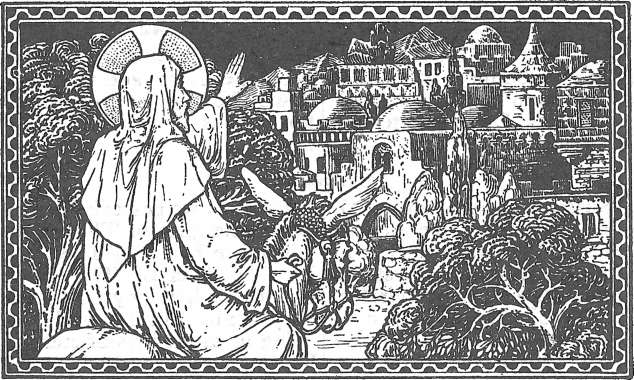
After Solomon's death the twelve tribes of Israel were divided into two kingdoms, Israel and Juda. The second of these consisted of the tribes of Juda and Benjamin, with Jerusalem as capital, while the first was composed of the remaining ten tribes, having for its capital Sichem, then Samaria.
To this latter kingdom belonged the prophet Elias, who dwelt in the desert of Galaad in Samaria. A man of great virtue and austere life he wore a tunic woven of camel's hair and a leathern girdle. " With zeal, zealous for the Lord God of Hosts", he left the desert three times to convey the divine warnings to Achab, the seventh king of Israel and the queen, Jezebel, who seduced the people into idolatry ; to secure the death of the four hundred and fifty prophets of Baal whom he had put to confusion on Mount Carmel, and to foretell to the king who had taken Naboth's vineyard for himself, that he would die bathed in his own blood, and to the queen, who had been Achab's evil genius, that her blood would flow on the spot where Naboth's flowed, while dogs should devour her flesh.
For these reasons Elias was persecuted by the Israelites and by Achab and Jezebel, and was obliged to flee to Mount Horeb to escape death. Later on, when Ochozias Achab's son had become king, Elias advised him not to consult Beelzebub the god of Accaron as he intended but rather the God of Israel.
Upon this Ochozias sent him a captain of fifty soldiers to summon him to come down from the mountain and to account for his words, but Elias answered: " If I be a man of God, let fire come down from heaven and consume thee, and thy fifty." And there came down fire from heaven, and consumed him and the fifty that were with him (Breviary).
Still later, Elias set out towards the Jordan with Eliseus, and when they had crossed the river, a fiery chariot and horses separated them from each other, while Elias went up by a whirlwind into heaven. Then Eliseus took up Elias's mantle that had fallen from him, and received a double portion of his spirit, while all Elias' disciples exclaimed: "The spirit of Elias hath rested upon Eliseus."
On one ocassion, when Elias was on his way up to Bethel he was mocked by some small boys, crying: "Go up, thou bald head. Go up, thou bald head." And Elias cursed them in the name of God whom they had offended, "and there came forth two bears out of the forest and tore them two and forty boys."
All his life, Elias, with his words of fire, championed the rights of almighty God. Much later John the Baptist "came forward in the spirit and power of Elias", clad like him, and like him dwelling in the desert; defending, with the same impassioned voice, the same rights of God, and foretelling the separation which Christ, who was at hand, would make between the chaff and the wheat. " He will gather the wheat into his barns, but the chaff he will burn with unquenchable fire." " Elias," says St. Augustine, " was a type of our Redeemer and Lord. Elias suffered persecution from the Jews; our Lord, the true Elias, was despised and rejected by this same people. Elias left his own country; Christ forsook the synagogue and made welcome the Gentiles " (2nd Nocturn).
_Continuing the comparison, we may say that God rescued Elias from his enemies by raising him into the sky; and in the same way he took Christ from among His enemies, by making Him go up to heaven on Ascension Day. "Deliver me from my enemies, O my God, and defend me from them that rise up against me." (Alleluia).
Elias, carried away in a chariot of fire, was in the language of the Fathers, the type of Jesus ascending to heaven. The Gradual uses the same verse of the eighth psalm which the liturgy employs on Ascension Day. " O Lord, our Lord, how admirable is thy name in the whole earth. Thy magnificence is elevated above the heavens." The Introit adds : " Behold God is my helper and the Lord is the protector of my soul. Save me, O God, by Thy name and deliver me by Thy strength." This triumph of Christ over those who hated Him, typified by that of Elias over his despisers, will be ours also, if we do not "tempt Christ", that is, if we avoid idolatry, impurity, and murmuring (Epistle), remaining faithful to grace. For if our Lord continues to be offered up on our altars to "make His work to avail on our behalf " (Secret), and if "eating His Flesh and drinking His Blood, we abide in Him and He in us" (Communion), it is in order that "united" to Him (Postcommunion) we may faithfully keep His judgments which are "sweeter than honey" (Offertory).
St. Paul indeed, tells us: "God is faithful, who will not suffer you to be tempted above that which you are able; but will make also with temptation issue, that you may be able to bear it" (Epistle). Let us therefore, beseech the Lord that His merciful ears "may be open to the prayers" of His suppliants and, in order that to those who seek He may surely give that for which they ask, He may make us to ask only for those things which are well-pleasing to Him (Collect).
But divine justice is not content with protecting the just against their enemies and with rewarding them for their fidelity; it punishes also those who do evil. Elias threatened the faithless kingdom of Israel and made fire from heaven to fall on his enemies (Breviary). The Israelites who tempted Christ by their murmurings perished by fiery serpents (Epistle), and Jerusalem, over which our Lord wept and whose punishment he foretold for its rejection of Himself, was destroyed by war and fire (Gospel). Three and twenty thousand of the children of Israel, we read, perished in one day through fornication and many were destroyed because of their murmuring. " Now," St. Paul tells us, " all these things happened to them in figure, and they are written for our correction " (Epistle).
More than a million Jews perished at the destruction of Jerusalem because they had rejected the Messias, and in the Gospel (see the first Sunday of Advent and the twenty-fourth after Pentecost), our Lord always compared this tragic ending to the catastrophies which will mark the end of all time when God will come to judge the world by fire
At that moment, the divine judge will accomplish the separation of the good from the evil, rewarding the first and banishing from the kingdom of God all who have denied Him by their unbelief or their sin, just as He drove from the Temple, the type of the Church on earth and in heaven, the traffickers who had transformed that house of God into a den of thieves (Gospel). " Turn back the evils upon my enemies, and cut them off in Thy truth, O Lord my protector " (Introit). For then the time of mercy will have passed, and that of justice only will remain. " Wherefore," says the apostle, " he that thinketh himself to stand, let him take heed lest he fall " (Epistle).
Ecce Deus adjuvat me, et Dominus susceptor est animae meae : averte mala inimicis meis, et in veritate tua disperde illos, protector meus, Domine. * Deus, in nomine tuo salvum me fac : et in virtute tua libera me.
Behold God is my helper, and the Lord is the protector of my soul: turn back the evils upon my enemies, and cut them off in Thy truth, O Lord my protector. * Save me, O God, by Thy name, and deliver me in Thy strength.
(From the Introit of Mass, Psalm 53:6-7,3)
Pateant aures misericordiae tuae, Domine, precibus supplicantium: et ut petentibus desiderata concedas; fac eos, quae tibi sunt placita, postulare.
Let Thy merciful ears, O Lord, be open to the prayers of Thy suppliant people; and that Thou mayest grant them their petitions, make them to ask such things as shall please Thee. Through our Lord.
(Collect)
Continuation of the holy Gospel according to St. Luke.
At that time, when Jesus drew near to Jerusalem, seeing the city, He wept over it saying : If thou also hadst known, and that in this day, the things that are to thy peace : but now they are hidden from thy eyes. For the days shall come upon thee, and thy enemies shall cast a trench about thee, and compass thee round, and straiten thee on every side; and beat thee flat to the ground, and thy children who are in thee; and they shall not leave in thee a stone upon a stone, because thou hast not known the time of thy visitation. And entering into the temple, He began to cast out them that sold therein, and them that bought, saying to them: It is written, My house is the house of prayer, but you have made it a den of thieves. And He was teaching daily in the temple.
(St Luke 19:41-47)
Sunday, 15 July 2018
8th Sunday after Pentecost
Eighth Sunday after Pentecost
 At Pentecost the Church received the outpouring of the Holy Ghost and to-day's liturgy shows us its happy results. This blessed Spirit makes us children of God since we are led by Him to say in simple truth: Our Father. Therefore we are assured of our heavenly inheritance (Epistle). But to obtain this assurance we must live for God, in living by Him (Collect), letting ourselves be led in all things by the Spirit of God (Epistle), so shall we one day be welcomed by God into everlasting dwellings (Gospel).
In this lies the true wisdom we learn from the story of Solomon, the reading of which is continued in the Breviary during this week, where an account is given of the great work to which this great king devoted his whole life.
Solomon built the temple of the Lord in the city of Jerusalem in obedience to the wish of his father David, who could not build it himself because of the unceasing wars waged against him by his enemies. Solomon took three years to prepare the material, namely, the stones which eighty thousand men dug out of the quarries of Jerusalem and wood from the cedars and cypresses, felled by thirty thousand men on Mount Libanus in the kingdom of Hiram. When all preparations had been made, the actual building was begun in the four hundred and eightieth year after the flight from Egypt, and lasted seven years. Hewn stone, woodwork and panelling had been so exactly measured beforehand that the work took place in the greatest possible silence. In God's house was heard neither axe nor hammer nor any iron tool while the building was going on.
For the plans of his temple, Solomon took Moses' tabernacle; giving it much larger proportions and accumulating it in all the riches that he could. The floors and ceilings made of precious wood were set off with plates of gold and the altars and tables were all gilded, while the candelabra and sacred vessels were of solid gold. Gilt palms and cherubim adorned all the temple walls.
When the work was finished, Solomon dedicated the temple to the Lord with great solemnity. In the presence of all the elders of Israel and of an immense crowd of people, representing the twelve tribes, the priests brought in the Ark of the Covenant, containing Moses' Tables of the Law, to its place under the spread wings of two gilt cherubim, ten cubits high, which stood in the Holy of Holies. Thousands of sheep and oxen were sacrificed, and as the priests left the Holy of Holies a cloud filled the House of the Lord.
Then Solomon, raising his eyes to heaven, besought almighty God to hear the supplications of all those, Israelite or stranger, who should come in the varying circumstances of their lives, to pray to Him in this place, consecrated to His Name. Moreover, he asked that God would hear those who, with face turned towards Jerusalem and the temple, should address their petitions to Him, to show clearly that He had chosen this house for His abode and that nowhere else was there a God like that of Israel.
The celebration of the Dedication of the temple lasted fourteen days, accompanied by sacrifices and sacred feasts, after which the people returned home, blessing the king and with grateful hearts for all the good that the Lord had done to Israel since the days of the Covenant on Sinai. And the Lord, appearing to Solomon a second time, said in effect: "I have heard thy prayer ... I choose and sanctify this house which thou hast built, my eyes and my heart shall be there always to watch over my faithful people."
In to-day's Mass, the Church sings some verses of six different psalms in which are summed up all the thoughts expressed in Solomon's prayer. "Great is the Lord and exceedingly to be praised, in the city of God, in his holy mountain" (Introit and Alleluia). "Who is God, but Thee, O Lord?" (Offertory). It is "in the midst of his" temple, that the outpouring of God's mercy is received (Introit), and that one may "taste and see that the Lord is sweet" (Communion), for He is "a God-protector and a place of refuge", for all who hope in Him (Gradual).
In the same way that Solomon's reign was a rough copy and image of that of Christ (2nd Nocturn), so the temple which he built at Jerusalem was but a figure of heaven, where God dwells and where He hears the prayers of men. It is to the holy mountain and the city of God (Alleluia) that we shall go one day to praise Him forever, for the Epistle tells us that if we live by the Spirit, mortifying the deeds of the flesh within us, we are the children of God, and therefore, as heirs of God and joint heirs with Christ we shall enter heaven, the place of our inheritance.
The Gospel completes this thought when it tells us, in the form of a parable, how we can use the "mammon of iniquity" to make sure of our entry into everlasting dwellings. An unjust steward, charged with having wasted his master's goods, makes friends for himself with the help of the goods the latter had entrusted to his care, that after his disgrace there might be those who would receive him into their houses.
Thus, teaches our Lord, should the children of light rival the energy of the children of the world, and copying the foresight of this functionary, make use of the goods placed at their disposal by almighty God to help the needy, thus making for themselves friends in heaven. For those who have borne their privations on earth in a Christian spirit will pass to the world above and will there bear witness to their benefactors at the time when all will have to give account of their stewardship to the divine Judge.
Suscepimus, Deus, misericordiam tuam in medio templi tui: secundum nomen tuum, Deus, ita et laus tua in fines terrae: justitia plena est dextera tua. * Magnus Dominus, et laudabilis nimis: in civitate Dei nostri, in monte sancto ejus.
We have received Thy mercy, O God, in the midst of Thy temple; according to Thy name, O God, so also is Thy praise unto the ends of the earth : Thy right hand is full of justice. * Great is the Lord, and exceedingly to be praised, in the city of God, in his holy mountain.
(Psalm 47:10-11,2 from the introit of Mass)
Largire nobis, quaesumus, Domine, semper spiritum cogitandi quae recta sunt, propitius et agendi: ut, qui sine te esse non possumus, secundum te vivere valeamus.
Grant to us, O Lord, we beseech Thee, the spirit to think and do always such things as are right; that we who cannot exist without Thee, may be able to live according to Thy will.
(Collect)
Continuation of the holy Gospel according to St. Luke.
At that time, Jesus spoke to His disciples this parable: There was a certain rich man who had a steward; and the same was accused unto him that he had wasted his goods; and he called him, and said to him: How is it that I hear this of thee? give an account of thy stewardship, for now thou canst be steward no longer. And the steward said within himself: What shall I do, because my lord taketh away from me the stewardship? To dig I am not able: to beg I am ashamed. I know what I will do, that when I shall be put out of the stewardship, they may receive me into their houses. Therefore calling together every one of his lord's debtors, he said to the first: How much dost thou owe my lord? But he said: A hundred barrels of oil. And he said to him: Take thy bill, and sit down quickly, and write fifty. Then he said to another: And how much dost thou owe? Who said: A hundred quarters of wheat. He said to him: Take thy bill, and write eighty. And the lord commended the unjust steward, for as much as he had done wisely: for the children of this world are wiser in their generation than the children of light. And I say to you: Make unto you friends of the mammon of iniquity, that when you shall fail, they may receive you into everlasting dwellings.
(St Luke 16:1-9)

In this lies the true wisdom we learn from the story of Solomon, the reading of which is continued in the Breviary during this week, where an account is given of the great work to which this great king devoted his whole life.
Solomon built the temple of the Lord in the city of Jerusalem in obedience to the wish of his father David, who could not build it himself because of the unceasing wars waged against him by his enemies. Solomon took three years to prepare the material, namely, the stones which eighty thousand men dug out of the quarries of Jerusalem and wood from the cedars and cypresses, felled by thirty thousand men on Mount Libanus in the kingdom of Hiram. When all preparations had been made, the actual building was begun in the four hundred and eightieth year after the flight from Egypt, and lasted seven years. Hewn stone, woodwork and panelling had been so exactly measured beforehand that the work took place in the greatest possible silence. In God's house was heard neither axe nor hammer nor any iron tool while the building was going on.
For the plans of his temple, Solomon took Moses' tabernacle; giving it much larger proportions and accumulating it in all the riches that he could. The floors and ceilings made of precious wood were set off with plates of gold and the altars and tables were all gilded, while the candelabra and sacred vessels were of solid gold. Gilt palms and cherubim adorned all the temple walls.
When the work was finished, Solomon dedicated the temple to the Lord with great solemnity. In the presence of all the elders of Israel and of an immense crowd of people, representing the twelve tribes, the priests brought in the Ark of the Covenant, containing Moses' Tables of the Law, to its place under the spread wings of two gilt cherubim, ten cubits high, which stood in the Holy of Holies. Thousands of sheep and oxen were sacrificed, and as the priests left the Holy of Holies a cloud filled the House of the Lord.
Then Solomon, raising his eyes to heaven, besought almighty God to hear the supplications of all those, Israelite or stranger, who should come in the varying circumstances of their lives, to pray to Him in this place, consecrated to His Name. Moreover, he asked that God would hear those who, with face turned towards Jerusalem and the temple, should address their petitions to Him, to show clearly that He had chosen this house for His abode and that nowhere else was there a God like that of Israel.
The celebration of the Dedication of the temple lasted fourteen days, accompanied by sacrifices and sacred feasts, after which the people returned home, blessing the king and with grateful hearts for all the good that the Lord had done to Israel since the days of the Covenant on Sinai. And the Lord, appearing to Solomon a second time, said in effect: "I have heard thy prayer ... I choose and sanctify this house which thou hast built, my eyes and my heart shall be there always to watch over my faithful people."
In to-day's Mass, the Church sings some verses of six different psalms in which are summed up all the thoughts expressed in Solomon's prayer. "Great is the Lord and exceedingly to be praised, in the city of God, in his holy mountain" (Introit and Alleluia). "Who is God, but Thee, O Lord?" (Offertory). It is "in the midst of his" temple, that the outpouring of God's mercy is received (Introit), and that one may "taste and see that the Lord is sweet" (Communion), for He is "a God-protector and a place of refuge", for all who hope in Him (Gradual).
In the same way that Solomon's reign was a rough copy and image of that of Christ (2nd Nocturn), so the temple which he built at Jerusalem was but a figure of heaven, where God dwells and where He hears the prayers of men. It is to the holy mountain and the city of God (Alleluia) that we shall go one day to praise Him forever, for the Epistle tells us that if we live by the Spirit, mortifying the deeds of the flesh within us, we are the children of God, and therefore, as heirs of God and joint heirs with Christ we shall enter heaven, the place of our inheritance.
The Gospel completes this thought when it tells us, in the form of a parable, how we can use the "mammon of iniquity" to make sure of our entry into everlasting dwellings. An unjust steward, charged with having wasted his master's goods, makes friends for himself with the help of the goods the latter had entrusted to his care, that after his disgrace there might be those who would receive him into their houses.
Thus, teaches our Lord, should the children of light rival the energy of the children of the world, and copying the foresight of this functionary, make use of the goods placed at their disposal by almighty God to help the needy, thus making for themselves friends in heaven. For those who have borne their privations on earth in a Christian spirit will pass to the world above and will there bear witness to their benefactors at the time when all will have to give account of their stewardship to the divine Judge.
Suscepimus, Deus, misericordiam tuam in medio templi tui: secundum nomen tuum, Deus, ita et laus tua in fines terrae: justitia plena est dextera tua. * Magnus Dominus, et laudabilis nimis: in civitate Dei nostri, in monte sancto ejus.
We have received Thy mercy, O God, in the midst of Thy temple; according to Thy name, O God, so also is Thy praise unto the ends of the earth : Thy right hand is full of justice. * Great is the Lord, and exceedingly to be praised, in the city of God, in his holy mountain.
(Psalm 47:10-11,2 from the introit of Mass)
Largire nobis, quaesumus, Domine, semper spiritum cogitandi quae recta sunt, propitius et agendi: ut, qui sine te esse non possumus, secundum te vivere valeamus.
Grant to us, O Lord, we beseech Thee, the spirit to think and do always such things as are right; that we who cannot exist without Thee, may be able to live according to Thy will.
(Collect)
Continuation of the holy Gospel according to St. Luke.
At that time, Jesus spoke to His disciples this parable: There was a certain rich man who had a steward; and the same was accused unto him that he had wasted his goods; and he called him, and said to him: How is it that I hear this of thee? give an account of thy stewardship, for now thou canst be steward no longer. And the steward said within himself: What shall I do, because my lord taketh away from me the stewardship? To dig I am not able: to beg I am ashamed. I know what I will do, that when I shall be put out of the stewardship, they may receive me into their houses. Therefore calling together every one of his lord's debtors, he said to the first: How much dost thou owe my lord? But he said: A hundred barrels of oil. And he said to him: Take thy bill, and sit down quickly, and write fifty. Then he said to another: And how much dost thou owe? Who said: A hundred quarters of wheat. He said to him: Take thy bill, and write eighty. And the lord commended the unjust steward, for as much as he had done wisely: for the children of this world are wiser in their generation than the children of light. And I say to you: Make unto you friends of the mammon of iniquity, that when you shall fail, they may receive you into everlasting dwellings.
(St Luke 16:1-9)
Subscribe to:
Posts (Atom)