Introduction

This blog contains regular postings relating to the Traditional Latin Liturgy of the Roman Catholic Church. It includes regular commentary on the saints days and the liturgical cycle, with brief background and extracts from the liturgy both in Latin and English. Much of the material has been extracted from the 'St Andrew's Daily Missal', Dom Gueranger's 'Liturgical Year', or similar sources.

Related website: http://www.liturgialatina.org/


Wednesday, 30 November 2011

Office for the Dead, Dominican Rite

A brief comparison of the Traditional Office for the Dead in the Dominican Rite with the Roman Rite.

I recently undertook to say the Office for the Dead in the Dominican rite for a deceased acquaintance who was a Tertiary of the Order, so have been reflecting on the minor variations between these forms of the Office. The differences are minor but, to the careful liturgical observer, interesting.

The main difference is in the order of the responsories at Matins, with a characteristic version of the final responsory Libera me (other religious orders seem to have had variations on that one as well). Otherwise, there is a different Magnificat Antiphon at Vespers, and a few minor variations to the text, as outlined below.

The Roman Office for the Dead may be consulted on the website breviary.net which also contains a brief introduction to this Office.

There is also a general introduction in the Catholic Encyclopaedia:
http://www.newadvent.org/cathen/11220a.htm

According to Fr William Bonniwell, in his History of the Dominican Liturgy,

"The final choral obligation of the friars was the office of the dead. The addition of it to the Divine Office is also attributed to Innocent III. This office is believed to have originated at Rome in the eighth century. The body of the deceased was brought to the church in the evening; after its arrival the office would begin. It was really a vigil, and as such had vespers, three nocturns and lauds. That is why Humbert refers to this office as the "vigil." Humbert speaks of two different kinds of office for the dead, the vigil of nine lessons and the vigil of three lessons. The former is what is known commonly today as the office of the dead; it was said every week, though there were exceptions to the rule. The latter office, which has disappeared from the Dominican rite, needs some explanation. It was said as follows: on Sunday and Wednesday, the psalms of the first nocturn, together with its antiphons, versicle, lessons and responds; on Monday and Thursday, the psalms, etc., of the second noctum; on Tuesday and Friday, those of the third nocturn. The prayers used in the office were the same as those used to-day for "familiares and benefactors of the Order." The entire community did not say the office; only the hebdomadarian of the week, with the deacon, subdeacon and friar who were assigned for that week to the Mass of the Dead. But the ordinary adds: "Any others who wish to do so, may be present." This office was recited nearly every day."
(Second edition, 1945, pp146-7)

The variations in the Dominican from the Roman rite are as follows:

There is no Pater or Ave (or Credo) said before the hours.

There is no versicle and response V. Audivi vocem etc. at Vespers and Lauds after the psalmondy.

However, this is converted into an antiphon in its own right which is used at the Magnificat at Vespers instead of the Roman Omne quod dat mihi. Here is the text from the Dominican Antiphonal of 1933:


The Pater noster is said silently after the Magnificat and Benedictus, i.e. the last two lines are not said as versicle and response, unlike in the Roman rite.

After Psalm 145 or 129 the following is used:

V. A porta ínferi.
R. Erue, Dómine, ánimas eórum.
V. Dóminus vobíscum.
R. Et cum spíritu tuo.
(or
V. Dómine, exáudi oratiónem meam.
R. Et clamor meus ad te véniat.)
Then the Collect.

After the Collect is said only:
V. Requiéscant in pace.
R. Amen.

There is never an invitatory and psalm Venite exsultemus before Matins; whereas in the Roman rite this is used whenever Matins of 3 nocturns is recited.

The Pater noster in each nocturn, before the readings, has its final two verses said as versicle and response.

The responsories of the first nocturn are the same as in the Roman rite. The responsory after the third reading does not contain V. Requiem aeternam etc. at the end, unlike in the Roman rite.

The responsory after the first reading of the second nocturn is Heu mihi etc. which is used in the Roman rite after the second reading; the responsory after the second reading is Ne recorderis etc. which is used in the Roman rite after the third reading; the responsory after the third reading is as follows, which is a variant of that used in the Roman rite after the second lesson of the third nocturn:

R. Dómine, secúndum actum meum noli me judicáre: nihil dignum in conspéctu tuo egi; * ídeo déprecor majestátem tuam, ut tu, Deus, déleas iniquitátem meam.
V. Amplius lava me, Dómine, ab injustítia mea, et a delícto meo munda me: quia tibi soli peccavi. * ideo deprecor majestatem tuam, ut tu, Deus deleas iniquitatem meam.

The responsory after the second reading of the third nocturn is Memento mei etc. which is a variant of that used in the Roman rite after the first reading of the second nocturn:

R. Meménto mei, Deus: quia ventus est vita mea, * Nec aspíciat me visus hóminis.
V. Et non revertetur oculus meus, ut videat bona. * Nec aspíciat me visus hóminis.

After the final reading of the third nocturn, the following responsory is used, which is a variant on that used in the Roman and other rites. This responsory is an ancient composition, and seems to have many variants.

R. Líbera me, Dómine, de morte aetérna in die illa treménda: * Quando caeli movéndi sunt et terra: * Dum véneris judicáre saeculum per ignem.
V. Dies illa, dies irae, calamitátis et misériae, dies magna et amára valde. * Quando caeli movéndi sunt et terra.
V. Tremens factus sum ego, et tímeo, dum discússio vénerit, atque ventúra ira. * Dum véneris judicáre saeculum per ignem.
V. Creator omnium rerum, Deus, qui me de limo terrae formasti, et mirabiliter proprio sanguine redemisti, corpusque meum, licet modo putrescat, de sepulcro facies in die judicii resuscitari: exaudi, exaudi me, ut animam meam in sinu Abrahae Patriarchae tui jubeas collocari.
R. Líbera me, Dómine, de morte aetérna in die illa treménda: * Quando caeli movéndi sunt et terra: * Dum véneris judicáre saeculum per ignem.


The versicle Creator omnium rerum isn't in the Roman. Here's a translation:


Creator of all things, O God, who formed me out of the dust of the earth, and wonderfully redeemed me with Thine own blood, and although I now decay, will make my body rise again from the sepulchre on the day of judgement: graciously hear me, so that you may command my soul to be placed into the bosom of the Patriarch Abraham.


(This chant is from the Dominican Antiphonale of 1862).

It is intended to follow up this article with similar ones on the Office of the Dead in the liturgies of other religious orders.

Tuesday, 8 November 2011

Octaves of Feasts

Octaves of Feasts

An octave is 8 days of commemoration of a major feast, including the day itself. The 8th day is called the octave day, and always falls on the same day of the week as the feast itself. So the octave day of Christmas is New Year's Day.

The first octave that was kept was the dedication of the Churches of Tyre and Jerusalem, under Constantine - these solemnities, in imitation of the dedication of the Jewish Temple, lasted eight days. In the fourth century, Easter and Pentecost were given octaves, and from this time onwards the celebration of octaves is becomes more frequent. In the sacramentaries of Gelasius and St. Gregory, on the octave day the office of the feast is repeated, but there was no provision for the intermediate days.

Amalarius tells us that it was customary in his time to celebrate the octaves of the feasts of SS. Peter and Paul and other saints. By the thirteenth century, perhaps under the influence of the Franciscans, octaves were extended to many other feasts.

In the Tridentine calendar of 1568, octaves were celebrated by the same office being repeated on each day of the octave. Some octaves overlapped, especially in the period after Christmas, so there were multiple commemorations of octaves.


In the calendar, as reformed by Pope St Pius X in 1911, there are:


Privileged Octaves

1. Octaves of the first rank: Easter and Pentecost - no other feast may be celebrated during this time;

2. Octaves of the second rank: Epiphany and Corpus Christi - the octave days are greater doubles, and the days within the octave are semidoubles, being displaced only by doubles of the first class;

3. Octaves of the third rank: Christmas, Ascension, Sacred Heart - displaced by any feast day above rank of simple;


Common octaves

Immaculate Conception, Assumption, Nativity of Saint John the Baptist, Solemnity of St. Joseph, SS Peter and Paul, All Saints, and the principal patron saint of a church, cathedral, order, town, diocese, province, or nation - displaced by any feast day above rank of simple.


Simple octaves
Saint Stephen, Saint John the Evangelist, Holy Innocents, Saint Lawrence, Nativity of Mary, and secondary patrons - kept as doubles of the second class, octave day was a simple, no days within the octave commemorated.


In later reforms, octaves have come under the knife, as have vigils, the alleged principle being for greater simplicity. In the reform of 1955, only the octaves of Christmas, Easter and Pentecost were kept, and during these octaves there are no commemorations.

In the Novus Ordo, the octave of Pentecost was suppressed. This appears to have been a mistake, and took Paul VI by surprise when, on Whit Monday, he appeared at his private chapel to celebrate mass, and was met with green vestments, rather than the accustomed red for the Holy Spirit. "But, it's Whit Monday." "You've abolished it, Your Holiness."

One octave which is not celebrated liturgically, but is often observed, is the "Octave of prayer for Christian unity," which runs from 18th January to 25th January - from St Peter's Chair at Rome to the Conversion of St Paul. This was started in 1908, approved by Pope St Pius X, and Pope Benedict XV encouraged its observance throughout the church.

The Catholic encyclopaedia on Octaves: http://www.newadvent.org/cathen/11204a.htm

Saturday, 5 November 2011

'Work of Human Hands' on Youtube

"Work of Human Hands: A Theological Critique of the Mass of Paul VI" by Fr Anthony Cekada was published in 2010 by Philothea press - and has been praised highly in traditionalist periodicals, including 'Christian Order' and 'Usus Antiquior', although not necessarily supporting all of Fr Cekada's theological positions.

The book is a serious work of substantial scholarship, and is well worth reading by anyone seriously interested in what went wrong with the liturgical reforms of the 1960s and 1970s (which are, of course, still with us).

For those who want a briefer overview, there is now a Youtube channel, which is going to include a number of short videos, presented by Fr Cekada, about the content of his book. Each video will give an overview of a chapter from the book.

Fr Cekada argues that the difference between the two rites is not simply a matter of "beauty, preference and sentiment." Rather, "The doctrinal ideas behind the new rite are different to the doctrinal ideas behind the old rite." There is a different theology of the real presence and the purpose of the mass, which lies behind the difference in gestures, ritual, and language.

Two videos are already posted:

1. Old Mass of New: What's the Fuss?

2. The Liturgical Movement: The Change Agents

For more information about the book, including extracts, see the Philothea press:
http://www.philotheapress.com/store/work-of-human-hands -

It's also worth visiting the website that provides supplementary information and commentary about the book, including reviews by other traditionalists:
http://www.doctrinaliturgica.com/

Thursday, 27 October 2011

The Divine Praises

Act of Reparation for Blasphemy and Profanity

Blessed be God.
Blessed be His Holy Name.
Blessed be Jesus Christ, true God and true Man.
Blessed be the Name of Jesus.
Blessed be His Most Sacred Heart.
Blessed be His Most Precious Blood.
Blessed be Jesus in the Most Holy Sacrament of the Altar.
Blessed be the Holy Spirit, the Paraclete.
Blessed be the great Mother of God, Mary most Holy.
Blessed be her Holy and Immaculate Conception.
Blessed be her Glorious Assumption.
Blessed be the name of Mary, Virgin and Mother.
Blessed be St. Joseph, her most chaste spouse.
Blessed be God in His Angels and in His Saints. Amen.

These were originally written in Italian by Fr Luigi Felici SJ in 1797, in a shorter version. The invocations have been gradually added since then.


For the Propagation of the Faith

Missa pro Fidei Propagatione

Deus misereátur nostri, et benedícat nobis: illúminet vultum suum super nos, et misereátur nostri: ut cognoscámus in terra viam tuam, in ómnibus géntibus salutáre tuum. * Confiteántur tibi pópuli, Deus: confiteántur tibi pópuli omnes.
May God have mercy upon us, and bless us: may He cause the light of His countenance to shine upon us, and may He have mercy upon us: that we may know Thy way upon earth, Thy salvation in all nations. * Let the people confess to Thee, O God : let all people give praise to Thee.
(Psalm 66:2-4 from the Introit of Mass)

Deus, qui omnes hómines vis salvos fíeri et ad agnitiónem veritátis veníre: mitte, quaesumus, operários in messem tuam, et da eis cum omni fidúcia loqui verbum tuum; ut sermo tuus currat et clarificétur, et omnes gentes cognóscant te solum Deum verum, et quem misísti Jesum Christum, Fílium tuum, Dóminum nostrum.
O God, who desirest that all men should be saved, and come to the knowledge of Thy truth: send, we beseech Thee, labourers into Thy harvest, and grant them grace to speak Thy word with all trust: that Thy words may run and be glorified : and that all nations may know Thee the one true God, and Him whom Thou hast sent.
(Collect)

Lesson from the Book of Wisdom.
Have mercy upon us, O God of all, and behold us, and show us the light of Thy mercies : and send Thy fear upon the nations, that, have not sought after Thee : that they may know that there is no God beside Thee, and that they may show forth Thy wonders. Lift up Thy hand over the strange nations, that they may see Thy power. For as Thou hast been sanctified in us in their sight, so Thou shalt be magnified among them in our presence. That they may know Thee, as we also have known Thee, that there is no God beside Thee, O Lord. Renew Thy signs, and work new miracles. Glorify Thy hand, and Thy right arm. Raise up indignation, and pour out wrath. Take away the adversary, and crush the enemy. Hasten the time, and remember the end, that they may declare Thy wonderful works. Give testimony to them that are Thy creatures from the beginning, and raise up the prophecies which the former prophets spoke in Thy name. Reward them that patiently wait for Thee, that Thy prophets may be found faithful : and hear the prayers of Thy servants according to the blessing of Aaron over Thy people, and direct us into the way of justice, and let all know that dwell upon the earth that Thou art God, the beholder of all ages.
(Ecclus. 36:1-10,17-19)

Confiteántur tibi pópuli, Deus, confiteántur tibi pópuli omnes: terra dedit fructum suum.
V. Benedícat nos Deus, Deus noster, benedícat nos Deus: et métuant eum omnes fines terrae.
Let people confess to Thee, O God: let all people give praise to Thee: the earth hath yielded her fruit.
V. May God, our God, bless us, may God bless us: and all the ends of the earth fear Him.
(Gradual. Psalm 66:6-8.)

Allelúja, allelúja. V. Jubiláte Deo, omnis terra: servíte Dómino in lætítia: introíte in
conspéctu ejus, in exsultatióne. Allelúja.
Alleluia, alleluia. Sing joyfully to God, all the earth, serve ye the Lord with gladness : come in before His presence with exceeding great joy. Alleluia.
(Psalm 99:1.)

Sequéntia sancti Evangélii secúndum Matthaeum.
In illo témpore: Circuíbat Jesus omnes civitátes et castélla, docens in synagógis eórum, et praedicans Evangélium regni, et curans omnem languórem et omnem infirmitátem. Videns quia erant vexáti, et jacéntes sicut oves non habéntes pastórem. Tunc dicit discípulis suis: Messis quidem multa, operárii autem pauci. Rogáte ergo Dóminum messis, ut mittat operários in messem suam.
Continuation of the holy Gospel according to St. Matthew. At that time : Jesus went about all the cities and towns, teaching in their synagogues, and preaching the gospel of the kingdom, and healing every disease, and every infirmity. And seeing the multitudes, He had compassion on them : because they were distressed and lying like sheep that have no shepherd. Then He saith to His disciples : the harvest indeed is greats but the labourers are few. Pray ye therefore the Lord of the harvest, that He send forth labourers into His harvest.
(St Matthew 9:35-38.)

Afférte Dómino, pátriae géntium, afférte Dómino glóriam et honórem, afférte Dómino glóriam nómini ejus: tóllite hóstias, et introíte in átria ejus: adoráte Dóminum in átrio sancto ejus.
Bring unto the Lord, O ye kindred of the Gentiles, bring unto the Lord glory and honour, bring unto the Lord glory unto His name: bring sacrifices and come into His courts, adore ye the Lord in His holy court.
(Psalm 95:7-9. Offertory)

Protéctor noster, áspice, Deus, et réspice in fáciem Christi tui, qui dedit redemptiónem
semetípsum pro ómnibus: et fac; ut ab ortu solis usque ad occásum magnificétur nomen tuum in géntibus, ac in omni loco sacrificétur et offerátur nómini tuo oblátio munda.
Behold, O God our protector, and look upon the face of Thy Christ, who gave Himself a ransom for all: and grant that from the rising of the sun even unto the setting thereof Thy name may be exalted among the Gentiles, and that in every place a clean offering be sacrificed and offered to Thy name.
(Secret)

Laudáte Dóminum, omnes gentes: laudáte eum, omnes pópuli: quóniam confirmáta est super nos misericordia ejus, et véritas Dómini manet in ætérnum.
Praise the Lord all ye nations: praise Him all ye people: for His mercy is confirmed upon us; and the truth of the Lord remaineth for ever.
(Communion Psalm 116:1-2.)

Redemptiónis nostrae múnere vegetáti: quaesumus, Dómine; ut, hoc perpétuae salútis auxílio, fides semper vera profíciat.
Refreshed by this gift of our redemption, we beseech Thee, O Lord, that by means of this help to our eternal salvation the true faith may ever advance.
(Postcommunion)

Tuesday, 18 October 2011

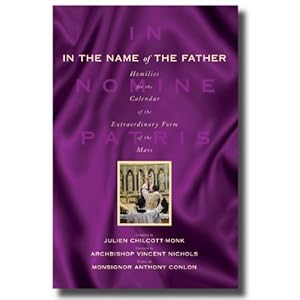
Book Review: "In the Name of the Father."


"In the Name of the Father: Homilies for Sundays and Feast days in the Extraordinary Form Calendar," edited by Julien Chilcott-Monk. Canterbury Press Norwich. £19.99 list price.


In the Name of the Father: Homilies for Sundays and Feast days in the Extraordinary Form Calendar

This is an excellent book for those who attend the old rite of mass on Sundays and feast days. It contains short homilies on the Gospels of the Sundays and major feast days throughout the year. That this should have been published now is a very welcome development, and indicates a wish by those who attend the old mass to nourish their spiritual life on it, and to engage in Lectio Divina based on the readings in it. Books of this type were of course common in the past. For the Novus Ordo, they still are, although the style isn't necessarily the same as that presented here.


The idea from this book was from one of the Oratorian fathers of Oxford - Fr. Dominic Jacob - to whom the book is dedicated. Most of the contributors, other than the editor, are priests of the Oxford Oratory, or other priests with either an Oratorian or an Oxford connection. Most of them will be well known to regular attenders of the old rite in southern England. One or two Oratorians are omitted, which is a pity - their erudition would have added to the book.

The first sermon I read, for the 20th Sunday after Pentecost, by Fr Anton Webb, was a masterly exposition of the Gospel of the day. The miracles of healing that Our Lord worked in Capernaum, related in the Gospel of St John and in the Synoptics, are compared. They are not the same miracle: in the one, the centurion, a gentile, shows great faith to the extent of not needing our Lord to come in person; in the other, by contrast, a ruler, a Jewish official from Herod's court, shows very limited faith, and needs to check on the time that the miracle took place to be reassured. Different qualities of faith, but even the limited faith of the ruler had its value. "We all have small beginnings and advance at different rates ... the greater example of the centurion urges us to press on and never to think that we have enough faith."

The sermon for the 21st Sunday after Pentecost, by Fr Nicholas Schofield, has a different flavour. It is certainly not lacking in learning, with a reference to St Augustine, and such examples from history as we would expect from the author. However, the sermon overall recalls us to the basic realities of the spiritual life - death, judgement, hell and heaven - in a thoroughly traditional, yet not pessimistic, manner. The liturgical year is passing away; so is this world. Let us always live mindful of its end, and our own. "These considerations should not make us morbid or lead us to despair. Rather, they challenge us to examine our lives, to make the most of God's grace and continual mercy, and strive for holiness."

The Sermon for All Saints Day, by Fr Dominic Jacob, is one that I have heard in church, so I greet it as an old friend. We envisage a great gulf between the saints in heaven, and ourselves in the here and now. We marvel at the words and works of the great saints - more admiration than emulation, often. But we are called to join them, that countless host that no man can number, who are commemorated on this day, so that eventually this will be our feast day too. Also, remember, that the saints weren't born as such - many of them started out with their full share of human failings. "We see in them what we are called to be, and are encouraged because they too experienced failure, trial and sin, yet by God's grace were strengthened to overcome the weakness of human nature."

There is a diversity of style in these sermons: some show biblical scholarship, some knowledge of the Fathers, some great insight into the spiritual life, some knowledge of the saints, and others simple piety and devotion. What they have in common is a straightforward focus upon the faith, and spiritual life, rather than merely academic points, or merely commonplace anecdotes. It is all practical - what must we do, and what must we know, to be saved - and a lot of learning is worn lightly. In the preface, Monsignor Antony Conlon - himself a skilled preacher - explains that genuine preaching isn't about artistry or stirring up the emotions, so much as the preacher putting his gifts at the service of the Church, in a spirit of docility and humility. He suggests that the Novus Ordo can encourage a style of preaching which is excessively autobiographical, with more emphasis on entertainment than on obedience, sacrifice and self-control. "Some forms of preaching thought to be pastorally effective remain only on the level of the ethical and humanitarian, and ignore the doctrinal and catechetical." These faults are absent from this volume, and it is better for it.

One further defect of many sermons, that isn't mentioned, is that they are often too long. I have heard too many a preacher, who would have given an excellent short sermon in ten minutes, lengthen it to twenty minutes or longer, and thereby ruin his good work. Few mass-goers have the patience to listen to long sermons with attention, and few preachers have the time or the talent to deliver engaging long sermons. The time for lectures is not during mass. Although the sermons in the book vary in length, they are all short, and in this also would be good models for others to follow.

Having praised the book highly, now to its main defect. It is regrettable that content which is of such high quality, and from a reputable publisher, should have been presented rather shoddily. It has, in fact, an air of being rushed, with the usual processes of copyediting and proof-reading being neglected. Those things that can be corrected by a spell-check are correct, but Latin words, punctuation, and some of the facts, are incorrect.

Some blemishes I noticed fairly quickly were:
1. The Transfiguration is referred to, both in the contents and in its proper place, as being on 4th August (rather than 6th);
2. Sometimes the S - standing for saint - has a full stop and sometimes not; at one point, John Henry Newman is referred to by the initials JHM;
3. In the preface, the Motu Proprio Summorum Pontificum is referred to as Romanum Pontificum;
3. Multiple typos in the Latin texts, for example:
In Anniversario Dedicatione Ecclesiae - should be Dedicationis, since it's the church that is dedicated, not the anniversary;
In Exultatione S. Crucis - should be Exaltatione;
Under 2nd February, the Nunc Dimittis is quoted inaccurately - plebes is given instead of plebis, and a similar error is made on 6th Sunday after Pentecost;
On Pentecost, terrarium is given instead of terrarum;
Famillae is given instead of Familiae for the Holy Family.
(This list isn't exhaustive.)

Now anybody can make an odd typo. It seems a pity, though, that there are so many typos in the Latin. If Latin sentences are given, they should at least be checked, and the impression given here is that nobody has cared enough to do this. This detracts from the quality of the book.

Overall, definitely worth having. Royalties from sale of the book will go to the Oxford Oratory "Renewal and Reaffirmation" appeal. The renovation of the Oratory Church is partially complete, but much more money is needed to finish the task, and this is a cause well worth supporting. From the Oratory Lodge, it costs the list price of £19.99; it's cheaper on Amazon, but less goes to the Appeal!

Wednesday, 17 August 2011

Mr Lazlo Kiss, Requiescat in Pace

Mr Lazslo Kiss, the webmaster of the excellent Divinumofficium website, died unexpectedly on 11th July.

Further details are available on the Rorate Coeli blog.

May his soul and the souls of all the faithful departed, through the mercy of God rest in peace.

His site is valuable for providing the texts for the daily office and for the mass, both in Latin and English (and Hungarian), and in several different versions. I've personally used it as an easy and accessible way of saying the Breviary in the two versions I use most commonly i.e. the immediately pre-1911 and immediately post-1911 forms. By providing 6 different versions of the office, from Monastic pre-Tridentine through to 1960 newcalendar, it was possible to see clearly the evolution of the office over that period.

It would appear from the Rorate Coeli blog that a new home has been found for the website.

May Mr Kiss rest in peace, and may his work on earth continue.

DF